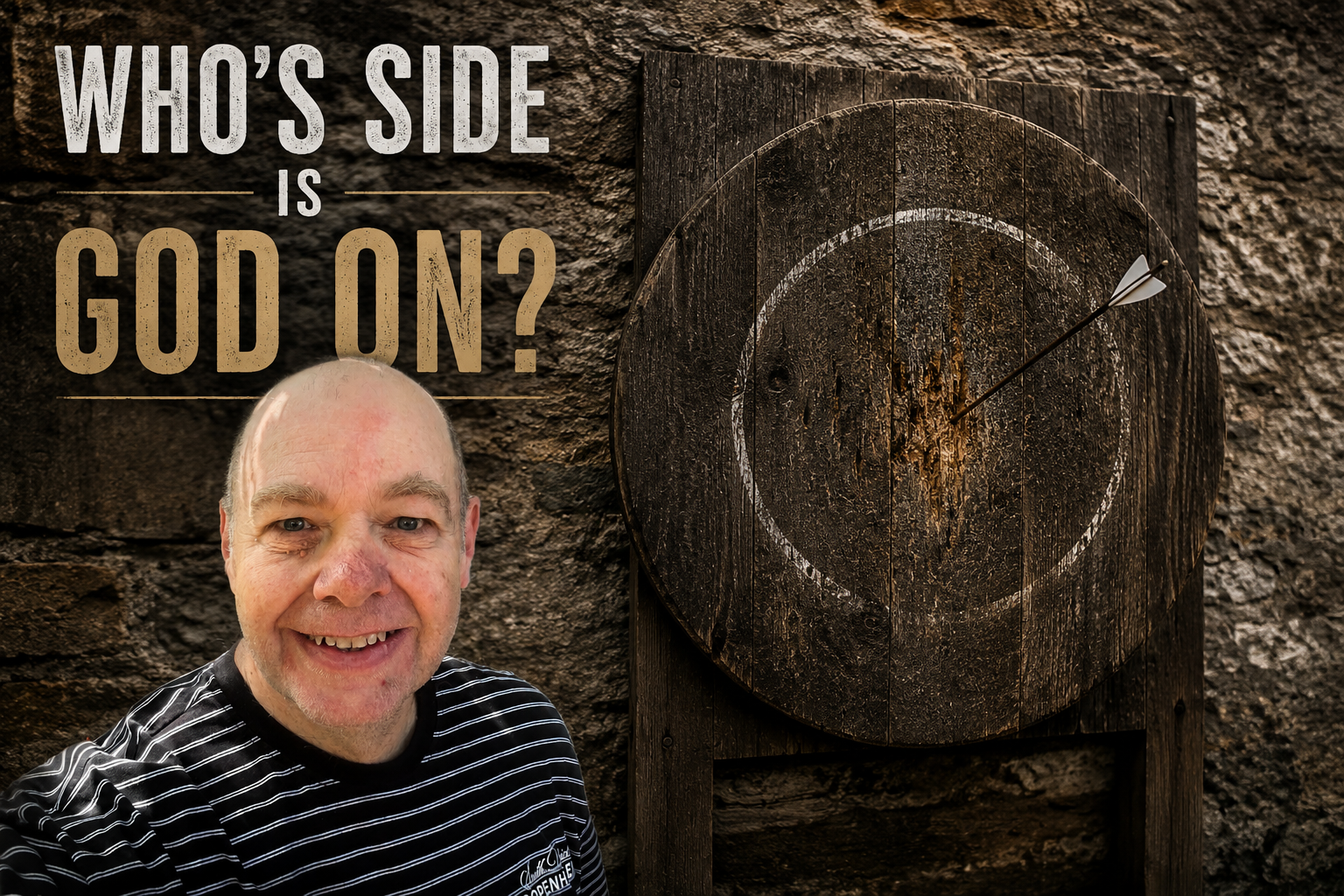
Whose Side Is God On?
I saw two things this week that wouldn’t leave me alone.
The first was a Christian on social media, already laying into our incoming Prime Minister before he’d even taken office. Called our parliamentarians lemmings. Reached for “Liebour” — that tired little slur, worn smooth from overuse, saying nothing except which tribe you’ve joined.
The second was gentler, and somehow more revealing. A lovely piece on Sky Sports about an Arsenal player’s faith — genuinely warm, no agenda. Scroll down far enough into the comments and there it was: someone joking that now he’d said “God,” the left would brand him far right.
Two incidents. Same disease. Different symptoms.
Here’s my question, and I don’t think it’s a comfortable one: do we, as Christians, have the right to add to a polarised climate? Not “are we allowed to have opinions” — of course we are. But are we entitled to pour our faith into the fire that’s already burning, and call it conviction?
I don’t think we are. And I think we need to talk about why.
Reform, the Christian vote, and the wrapping paper problem
Reform UK have worked out something the other parties largely haven’t: there are a lot of Christians in this country, and a lot of them feel unheard. So Farage talks about “Judeo-Christian culture” underpinning everything we are. His colleagues talk about restoring Britain’s Christian heritage, protecting churches, writing a “patriotic curriculum.” It’s targeted. It’s deliberate. And it’s working — the polling shows Christians shifting toward Reform in numbers nobody predicted five years ago.
I want to be fair here. Some of what Reform highlights is real. Family breakdown is real. The hollowing out of shared moral language is real. A church that only ever talks about justice for the stranger and never mentions the neighbour next door losing his sense of place in his own town has missed something too.
But naming a real problem doesn’t mean you’ve found a Christian solution to it. Because here’s the thing about “heritage Christianity” — it’s Christianity as wrapping paper. The gift inside is nation, culture, “our way of life.” Christ gets invoked to bless what was already decided, it’s the arrow and the target all over again. And that is precisely backwards. Jesus never told a disciple to go and restore his nation’s heritage. He told them to take up a cross, love the stranger, feed the hungry, and count the cost of following him above every other loyalty — nation and political ideology included.
When “Christian values” becomes a slogan for keeping people out rather than a summons to lay yourself down, we haven’t found Christian politics. We’ve found politics wearing a collar.
Franklin Graham and the cost of proximity
I look across the Atlantic and I see where this road ends up, and it troubles me deeply.
Earlier this year, an AI-generated image did the rounds showing President Trump as a Christ-like healing figure — light, robes, hands laid on a man in a hospital bed. It caused real offence, and rightly so. Franklin Graham’s response wasn’t to grieve it. He called the whole controversy “a lot to do about nothing” and told the world Trump was the most pro-Christian, pro-life president of his lifetime. He’s done this before — when charges were brought against Trump, Graham called them “politically motivated” and asked Christians to pray for protection, not to weigh the substance.
I want to be careful with a man’s name, because I believe Graham loves Jesus. But here’s what troubles me: even people who agree with Graham politically — even Marjorie Taylor Greene, of all people — looked at this and said, this isn’t discernment, this is a man protecting his access.
That’s the warning for every one of us who has ever been close to power, whether that’s a Prime Minister or a parish council. Proximity to power has a cost, and the cost is usually your prophetic voice. The moment we’re more worried about losing the ear of the powerful than about telling them the truth, we’ve stopped being pastors and started being chaplains to an empire.
And before anyone on the left feels smug
Let’s not pretend this is a right-wing problem only. I’ve watched a strand of progressive Christianity quietly dissolve the parts of the gospel that were never going to poll well. Resurrection softened to metaphor. Sin re-categorised as something only systems do, never something I do. Judgment dropped altogether, because judgment doesn’t fit a message of unconditional inclusion.
Bonhoeffer had a phrase for this, and it wasn’t written with the left or right in mind — it applies to both. He called it cheap grace. Grace without repentance is cheap, whichever side is dispensing it. A gospel with all the discomfort sanded off isn’t a kinder gospel. It’s a different gospel.
So who gets to claim Christ?
Nobody. That’s the honest answer, and I think it’s actually good news.
There have been committed, praying Christians on every side of British politics for as long as there’s been a British politics — Christian socialists building the welfare state on gospel conviction, Christian conservatives contending for the family and the unborn, Liberal Democrats losing leadership positions rather than compromise their faith in public. The gospel has never fit neatly inside one manifesto, and the moment it does, someone’s forced it to fit.
I often illustrate this with the story of the archer who fires an arrow into a blank wall, then walks over and paints a target around wherever it landed. From a distance it looks like remarkable marksmanship. Up close, you realise the target was never there first — it was drawn on afterwards to fit the shot.
That’s what’s happening every time we reach for a party first and a theology second. We don’t examine Scripture and arrive, reluctantly or otherwise, at a political position. We pick our tribe — often for reasons that have nothing to do with faith at all — and then we paint the target of “biblical values” around wherever we’ve already landed. The arrow came first. The target came after. And we call it conviction.
So when I see a Christian mock our incoming Prime Minister with a slur before he’s done a single day’s work, I don’t hear conviction. I hear tribalism borrowing a collar. And when I see someone assume that a footballer talking about his faith must now be “far right,” I hear the exact same tribalism, just facing the other way.
What do we actually do with this?
I think it starts small, and it starts with us, not with parliament.
Test the conviction against the text before you test it against the manifesto. If you can’t find it in Christ’s own pattern, hold it loosely.
Refuse the tribal words. “Liebour.” “Far right.” They’re not arguments. They’re just flags, and flags don’t need thinking, they need waving.
Disagree loudly if you must — but honour the person while you do it. Peter didn’t say honour the leaders you voted for. He said honour everyone.
Hold your citizenship in the kingdom first, and your party card a distant second, always open to correction.
And engage — don’t retreat into pious silence and call it holiness. Withdrawal isn’t the counter-cultural move. Captured allegiance is the failure. Engaged, non-conforming presence is the calling.
A question I’m still sitting with
I’ll be honest — I replied to that post. The one slagging off our next Prime Minister before he’d even started. And now I’m not sure I was right to.
Part of me thinks the reply was worth it — silence in the face of that kind of language can look a lot like agreement. But part of me wonders if I just fed the very fire I’m asking us all to stop pouring fuel on. Did my reply add light, or did it just give the post another round of attention, another reason for the algorithm to push it further?
Bonhoeffer didn’t comment on every bad take of his day. He chose his moments, and he paid dearly for the ones he chose. Maybe that’s the real discipline here — not silence, and not a reply to everything, but discernment about which fires are actually worth stepping into.
I don’t have a tidy answer to close on. Just a question I think we should all be asking before we next hit “post”:
Is what I’m about to say going to add light, or just more heat?
Because God isn’t a Republican or Democrat He isn’t conservative, Labour, Reform, or a Lib Dem. And the moment we’re more certain he’s on our side than we are certain we’re on his — we’ve stopped doing theology, and started doing politics with a Bible in our hand.