The Treasure Your Algorithm Is Feeding You
Deb and I were at the European Athletics Championships in Birmingham. My phone knew it before I got there. For days I’d been served ad after ad — tickets, travel deals, hospitality packages, all tuned perfectly to an event I’d already booked for. And yet when we spoke to people who actually live in Birmingham, several of them had no idea it was happening. Same city. Same week. Completely different information diet.
That got me thinking.
A few days later, someone at prayer meeting raised the alarm about a “significant rise” in knife crime and violent crime. I’d read the opposite. So I looked it up properly. The ONS figures published this year show knife crime fell around 10% year-on-year, and knife-related homicides dropped 21% — the lowest number since records began in 1977. Overall homicides are at their lowest level since 1983. The trend is down. Sharply.
So why did it feel, in that room, like a settled fact that things are getting worse?
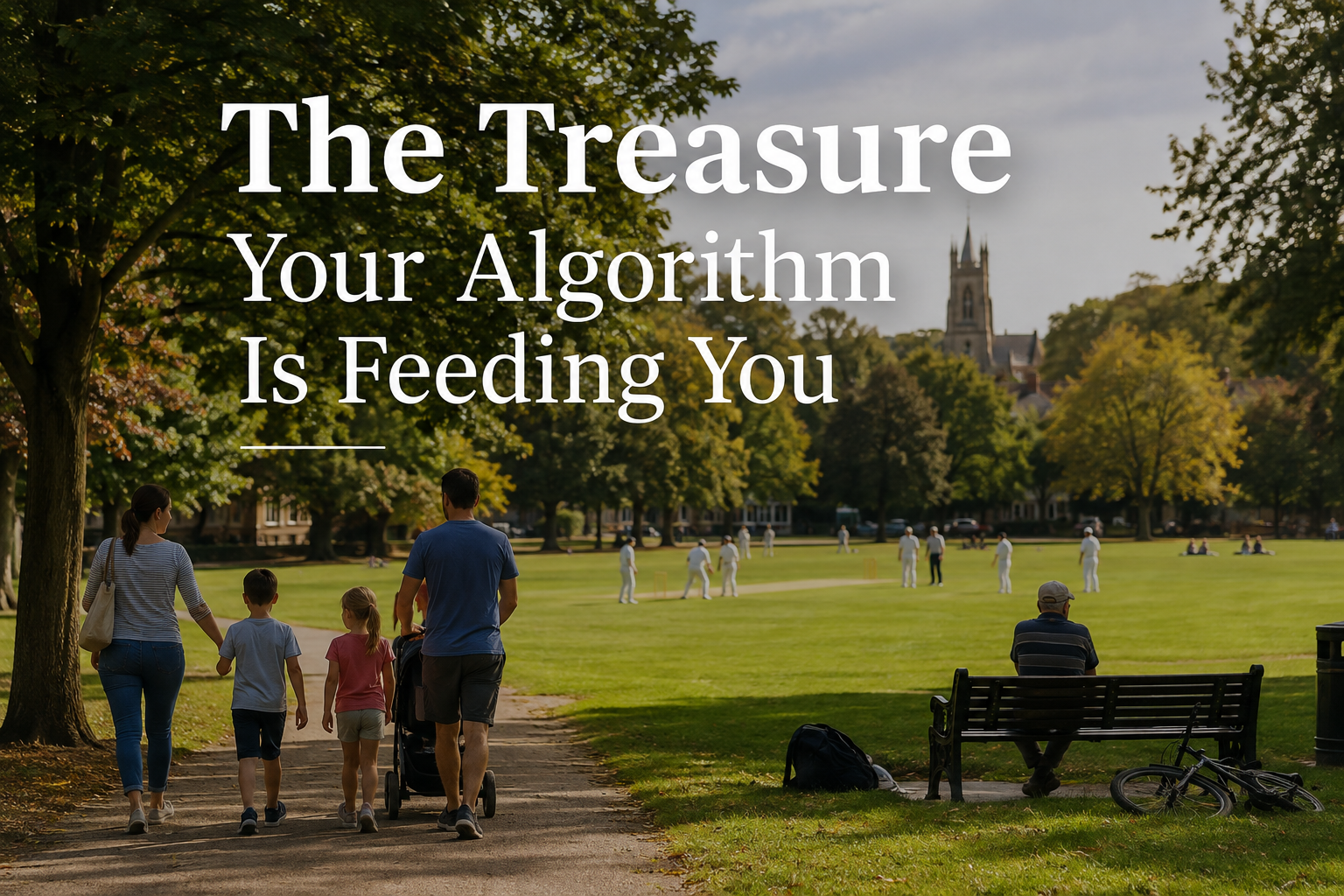
While we were in Birmingham, Deb and I took a walk through Perry Park. An American right-wing commentator had described it online as a no-go area for Christians. What we found was kids playing football, a couple of cricket games underway, people walking dogs, nothing remotely resembling danger. A similar claim gets made about Tower Hamlets in London — yet I have a friend who pastors a growing, thriving church there, a man who loves his patch and wouldn’t swap it for anywhere else.
Different accounts of the same places. Only one of them was made by someone who’d actually walked through.
What’s actually happening
None of this is really about knife crime, or Birmingham, or Perry Park. It’s about how we come to believe what we believe.
Algorithms don’t show you the world. They show you what keeps you scrolling — and fear is one of the most reliable levers there is. Researchers have a name for the result: “mean world syndrome,” the tendency of people who consume a heavy diet of threat-based content to believe the world is more dangerous than it actually is. Add AI into the mix and you get a second layer on top of the first — not just content selected to alarm you, but a system quietly trained to agree with whatever you already think. The loop doesn’t just feed you fear. It affirms you for being afraid.
That should trouble us. Not because the dangers aren’t ever real — they sometimes are — but because we’re increasingly forming our picture of reality from a feed engineered to distort it, and calling that picture “just seeing things as they are.”
Two verses that won’t leave me alone
Scripture keeps returning to two ideas that I think are more connected than we usually notice.
“God has not given us a spirit of fear, but of power and of love and of a sound mind.” (2 Timothy 1:7) That’s not a suggestion. It’s a command about posture — how we’re meant to stand in the world.
“Where your treasure is, there your heart will be also.” (Matthew 6:21) We tend to read that verse as being about money. But treasure is simply what we give our attention to, repeatedly, until it shapes us. And attention is precisely what these systems are built to capture.
Put the two together and you get an uncomfortable question: what if fear has become our treasure? Not chosen deliberately — nobody sets out to love being afraid — but accumulated, scroll by scroll, until our hearts have quietly relocated to wherever the algorithm keeps pointing.
So what do we do with that
I’m not arguing for naivety. Some threats are real and deserve a clear eye. But there’s a difference between discernment and a diet of manufactured dread — and increasingly, it takes real effort to tell them apart.
Maybe the discipline for our moment isn’t “stay informed.” It’s “ask what’s forming you, and whether you’d choose it deliberately if you could see it laid out plainly.” Go and look at the park yourself. Check the figures before you repeat the headline. Notice what you’re being shown, and ask who benefits from you believing it.
Because if our treasure is fear, that’s where our hearts will end up — no matter how sound the mind we started with.