


What Auschwitz Left Me With Part One: Auschwitz Didn’t Fall From the Sky
I went to Auschwitz yesterday with a strange feeling.
I’ve known about Auschwitz for most of my life. I’ve seen the photographs, watched the documentaries, read the history and heard the stories. Like most people, I knew what happened there.
But knowing something and standing in the place where it happened are two very different things.
I had also decided beforehand that I wasn’t going to take photographs.
That surprised me because I’m usually the person taking photographs of everything when I travel. But Auschwitz didn’t feel like somewhere I wanted to document as though it were another place I’d visited.
I was wrong.
As the day went on, I found myself taking more and more pictures.
Not selfies. Not photographs to post on Instagram or Facebook. I took them because I knew that, when I eventually went home, I would need something to remind me of what I had seen.
Something to make sure the horror I was seeing didn’t gradually become just another historical fact.
I decided not to publish any of them on social media.
That felt important to me.
While I was there, I saw people taking selfies, including on the railway tracks at Birkenau. I don’t know their stories, and I don’t know what was going through their minds, so I don’t want to judge them. People process difficult things differently.
But I have to admit that it jarred with me.
Those tracks aren’t simply an iconic backdrop for a photograph. They were part of the infrastructure that brought people into Auschwitz, many of whom would never leave.
There are places where I think the appropriate response is simply to stop and remember.
For me, Auschwitz was one of them.
The music
One of the things that affected me most was something I hadn’t really expected.
The music.
Just inside the entrance to Auschwitz I, beyond the infamous words Arbeit Macht Frei — “Work Sets You Free” — there is an area associated with the prisoners’ orchestra.
Music had been turned into part of the machinery of the camp.
Prisoners were required to march in formation to the music. They were exhausted, cold and starving, and those who failed to keep pace could be beaten or punished.
I’ve found that particularly difficult to process.
Perhaps because music means something very different to me.
Music has always been associated in my mind with healing, emotion, worship, memory and joy. As a Christian, I’ve always understood music as something that can lift the human spirit, express lament and help us connect with something beyond ourselves.
And here was music being used for almost the opposite purpose.
Something beautiful had been corrupted.
The Nazis didn’t just brutalise people’s bodies. They found ways of taking ordinary human things and turning them into instruments of control.
Even music.
I found that profoundly evil.
Six. Six. Six.
Later, at Auschwitz-Birkenau, we stood inside one of the barracks.
This was one of those moments when the scale of what happened became physical rather than historical.
The sleeping arrangements were almost impossible to comprehend. There were rows of crude wooden sleeping platforms, with six prisoners sharing what was essentially a plank-built bed. The platforms were arranged in three tiers, one above another.
Six people. Three levels.
As I stood there, I found myself thinking about the number 666.
For a Christian, 666 carries an obvious biblical association with evil and corrupt human power. It is the number associated with the beast in Revelation.
I don’t believe my watch was sending me a divine message, and I’m certainly not suggesting that it was.
But then I looked down at my pedometer.
6,667 steps.
It was one of those strange little moments that makes you stop.
Perhaps it meant nothing at all.
But standing in that barracks, surrounded by the physical evidence of what human beings had done to other human beings, the symbolism was difficult to ignore.
And it brought me back to something that had struck me throughout the day.
The evil of Auschwitz wasn’t abstract.
It had become organised.
It had buildings.
It had railway lines.
It had timetables.
It had paperwork.
It had uniforms.
It had rules.
It had punishments.
It had numbers.
And, horribly, it even had music.
Auschwitz didn’t fall from the sky
There is a phrase associated with the historian Jan Tomasz Gross:
“Auschwitz did not fall from the sky.”
I’ve found myself thinking about those words ever since I left the camp.
Because Auschwitz didn’t appear overnight.
There was a process.
Before there were gas chambers, there was propaganda.
Before there was mass murder, there was discrimination.
Before people were transported to camps, they had been identified, categorised, excluded and dehumanised.
Auschwitz was built by people.
People made decisions.
People followed orders.
People looked away.
People resisted.
People helped.
People betrayed.
People complied.
People survived.
That doesn’t diminish the responsibility of Nazi Germany for the Holocaust. Quite the opposite. It makes the history more disturbing because it reminds us that the Holocaust wasn’t some supernatural eruption of evil from nowhere.
It happened through human beings and human institutions.
And that is perhaps why Auschwitz leaves you with more questions than answers.
Because if evil always arrived looking like evil, perhaps it would be easier to recognise.
But it doesn’t.
Sometimes it arrives disguised as bureaucracy.
Sometimes as patriotism.
Sometimes as fear.
Sometimes as obedience.
Sometimes as indifference.
Sometimes even as something beautiful that has been twisted into something cruel.
And perhaps that is why I don’t want to leave Auschwitz simply thinking about Nazis.
I want to leave thinking about human beings.
About how easily we can divide the world into us and them.
About how quickly fear can become suspicion, suspicion can become contempt, and contempt can make things possible that once seemed impossible.
I came to Auschwitz thinking I was going to learn about the past.
I left wondering what it might have to teach me about the present.
And perhaps that is the real reason I took those photographs.
Not to say:
“Look where I’ve been.”
But to remind myself:
“Remember what happened here.”
Because Auschwitz didn’t fall from the sky.
And perhaps the uncomfortable question for all of us is not simply how something like Auschwitz could have happened then.
It is whether we are paying enough attention to the things that begin to happen before something like Auschwitz becomes possible.


What Is Wrong With People?
What happens to a person’s judgment in the gap between “I’d never say that to someone’s face” and “I’ll type it to a stranger online”?
This week gave several case studies at once: an RNLI crew abused for a rescue, Katie Piper in tears over her appearance, Rudy Giuliani shaking the hand of a mayor he’d just said shouldn’t be welcome — and the Tate brothers admitting in court that their entire online persona was a manufactured act for engagement and income.
I hate unfollowing people.
I follow a lot of people I don’t agree with, and on purpose. Christian leaders across the city, people from every wing of the Church, people well to my left and well to my right. I like hearing from people who see it differently to me. I think it’s healthy. I think it’s part of the job.
So it took me a couple of days to unfollow someone this week. I wrestled with it — turned it over, told myself I was overreacting, went back and looked again. In the end the answer didn’t change. A man who, I’d wager, would tell you he’s a Christian if you asked him. His feed isn’t debate. It isn’t even anger, really. It’s just gutter. Comment after comment, aimed at whoever the internet has decided to hate this week, dressed up as opinion. I didn’t block him. I just couldn’t have it in my timeline anymore.
It got me thinking about a question I can’t leave alone: what is actually wrong with people?
The lifeboat and the stone island stormtroopers
This week the RNLI became a target. Volunteers — unpaid, ordinary, the kind of people who leave a warm bed at 3am because someone else is drowning — have been abused online and in person for doing the only thing they’ve ever done: pulling people out of the sea.
The man at the front of a lot of this is Daniel Thomas, known online as Danny Tommo. He’s from Hayling Island.
I need to tell you what Hayling Island is to me before I tell you what it is to him. I spent most of my boyhood summers there. It’s a place stitched into the coast — a lifeboat station on the eastern side, looking out over the Solent, a community that has always understood what the sea can take from you if nobody comes. It’s not incidental to Hayling — it’s practically the town’s reason for being.
So when a man from that same stretch of coast stands in the water filming himself while lifeboat crews do their job, and calls them traitors for it — that lands differently for me than it might for you. It’s not abstract to me. It’s personal geography. He grew up somewhere that knows exactly what the RNLI is for, and he’s chosen to make his name attacking it anyway.
Not politics. Something else. What, exactly?
The woman who has already survived the worst thing
A few years back I was at St Joseph’s School in Stoke at an event with Katie Piper and her daughter Tegan. I watched her in the room — warm, funny, completely unguarded with a crowd of strangers. You wouldn’t have guessed, if you didn’t already know, what she’d walked through to get there. What struck me wasn’t the survival story. It was how much life she still had to give away.
This week she was in tears again — not over anything new, but over comments on her appearance after a red carpet event. A woman who survived an acid attack, who has already paid a price for existing in public that most of us can’t imagine, was made to justify her own face to strangers on the internet.
Danny Tommo. Katie Piper. A lifeboat crew. A pastor’s timeline. Different targets, same weather system. So — are people really this nasty? Or is something else going on?
The handshake that gave the game away
Rudy Giuliani said publicly that he didn’t want New York’s mayor, Zohran Mamdani, at the 25th anniversary of 9/11 — because Mamdani is Muslim. He said it offended him. Then the day came, the cameras were on, and Giuliani shook the man’s hand anyway.
I don’t know what changed in him between the interview and the ceremony. Maybe standing at Ground Zero does something to a person that a Newsmax studio doesn’t. But it’s a small, telling picture of the gap between what people are willing to say into a microphone or a comment box, and what they’re actually willing to do to a person’s face. The keyboard version of us is braver, uglier, and considerably less honest than the version that shows up in the room.
The persona was the product
Then there’s Andrew and Tristan Tate, who told a Florida court this year that the whole “uberwealthy” act — the rented Bugattis, the yacht that wasn’t theirs — was exactly that: an act. Their own lawyers said it plainly: the more outrageous the post, the more it’s shared, the more it pays. In short, they said, he’s playing a role.
I thought of Eminem, of all people — a song where he talks about kids at his shows mimicking what he does on stage, taking the character for the man. He’s been saying some version of that for twenty-five years: this is a performance, don’t confuse it with a plan for how to live. The Tates just said the quiet part in a courtroom instead of on a stage. Someone built a persona because outrage sells, millions of young men took it as a manual for manhood, and it took a bail hearing to get an admission that it was never meant to be real in the first place.
That’s the same engine as the RNLI abuse and the pile-on against Katie Piper, just running the other direction. In one, the cruelty gets aimed outward at a target. In the other, the cruelty is the product itself, manufactured and sold to people young enough to believe it’s a template. Either way, someone worked out that the ugliest version of a thing travels furthest, and built a business, or a feed, on that fact.
Something else is going on
I don’t think most of the people leaving those comments would say a single one of them to a face. It’s not a guess — it’s basically the whole of internet psychology in one sentence. Take away the face, take away the room, take away the pause where you’d see someone flinch, and something in us goes looking for permission it would never get in person.
Psychologists call it the online disinhibition effect. Behind a screen, you’re invisible enough to feel safe and distant enough to feel unreal — the RNLI volunteer or the woman in the gown stops being a person you’d have to look in the eye and becomes a character you’re arguing with in your own head. And once someone’s a character, you can say things to them you’d never say to a person.
There’s a second piece to it, and it’s the more damning one. Cruelty needs a story to hide behind, and people are remarkably good at building one on the spot. She’s a public figure, she signed up for this. They’re not really rescuers, they’re a taxi service. It’s just banter. Everyone’s saying it. None of it’s true, but it doesn’t need to be true — it just needs to be enough cover to let someone keep thinking of themselves as a decent person while they type something a decent person wouldn’t say.
And then there’s the machine underneath both of them. Contempt travels further than kindness ever will online, because outrage is what keeps people scrolling. The platforms didn’t invent cruelty. But they built a very efficient engine for rewarding it — which is exactly where this piece picks up the thread I started in “The Treasure Your Algorithm Is Feeding You.” Different fear, same feeding.
Punching down is not free speech
Somewhere along the way “I’m just saying what I think” became cover for going after people who are already carrying more than their share — a burns survivor, a charity volunteer, anyone the crowd has decided is fair game this week. That isn’t courage. Courage looks like challenging power, not piling onto someone who’s already been hurt once. Punching down dressed as plain speaking is still punching down.
Micah put it about as plainly as it can be put: do justice, love mercy, walk humbly. There’s no clause in there for “unless it’s on the internet and someone else started it.”
The good news this week
Here’s the part I want to end on, because it’s true and because it matters.
The RNLI has seen a surge in donations this week — new supporters, an outpouring of exactly the kind of decency the abuse was trying to drown out. Sir Robin Knox-Johnston called the intimidation what it was: disgraceful. And when Katie Piper posted through tears, she wasn’t left alone in it — the response from friends, colleagues and total strangers was immediate and warm, and by her own account she came through it still certain of who she is and whose she is.
That’s the answer to my own question, in the end. What’s wrong with people isn’t the whole story. Something in us does go looking for cover to be cruel from a distance. But something else in us — the bigger something, I think — still shows up when it matters. Still gives. Still says the kind thing out loud where the crowd can hear it.
I unfollowed one man this week. I could point you to a few hundred who make me glad I didn’t unfollow the internet altogether.


Two rulers
Stockton-on-Tees is a town of two postcodes standing almost shoulder to shoulder.
Drive ten minutes one way and you’ll find the kind of streets estate agents fight over. Drive ten minutes the other and you’ll find streets that wouldn’t look out of place on Benefit Street.
Same town. Same council. Two very different lives.
I saw it up close for years.
Deb and I were part of the leadership team at Destiny Church, a congregation that was, almost by accident and certainly by grace, a genuine mix of Black and white, comfortable and struggling.
Every Sunday, people who might otherwise never have met sat in the same room, sang the same songs and then went home carrying completely different burdens.
You learn something in a church like that.
You learn that privilege and disadvantage aren’t opposites.
We often talk about them as though they’re a seesaw. One person has privilege, another has disadvantage, and somehow the two must balance each other out.
But I don’t think life works like that.
A seesaw has one measurement: who’s higher and who’s lower. Life needs more than one ruler.
One ruler might measure race.
Another might measure class.
Another might measure family stability, education, geography or opportunity.
And if you put those rulers against the same person, you can get very different answers.
A young white man can have an advantage because he’s white and a profound disadvantage because he grew up poor.
Those two things don’t cancel each other out.
They don’t contradict each other.
They can both be true.
I’ve been thinking about that congregation again this week because of the seven young men who died on the A66 near Middlesbrough.
You’ve probably seen the headlines. A police pursuit. A terrible crash. Two police officers among the dead, alongside five teenagers and young men.
It’s the kind of story that encourages instant verdicts.
“No sympathy.”
“Look what deprivation does to people.”
But clean verdicts are rarely where the truth lives.
So, at the risk of annoying everyone, I think two things can be true at once.
Two rulers, not one seesaw
Let’s start with the uncomfortable one.
White privilege is real.
That doesn’t mean every white person has an easy life. It doesn’t mean poverty disappears because you’re white. And it certainly doesn’t mean someone growing up on a struggling estate has somehow won the lottery of life.
It simply means that race can make some aspects of life easier for a white person than they would otherwise be.
But here’s the other uncomfortable truth.
Growing up white in South Bank, or in some of the parts of Stoke I know well, or in Pillgwenlly in Newport, can still leave a young man facing educational outcomes, employment prospects and life chances that would horrify someone comparing his life with that of a more comfortable neighbour a few miles away.
These aren’t contradictory statements.
They’re measuring different things.
Race is one ruler.
Class and postcode are another.
Put both rulers against the same young man and you can get two truthful answers.
He can experience advantages because he’s white, while simultaneously being disadvantaged because he grew up poor.
Privilege in one area doesn’t magically cancel disadvantage in another.
That seems obvious to me now.
But it doesn’t always seem obvious in the public conversation.
The boys we keep failing
The educational figures around disadvantaged white boys should make us uncomfortable too.
For years, they have been among the poorest-performing groups educationally. Only a small proportion of the most disadvantaged white British boys go on to university.
Whatever we mean by “white privilege”, it plainly isn’t delivering much privilege in that classroom.
And I’ve seen the consequences of disadvantage elsewhere.
I’ve sat as a magistrate on the North Staffordshire bench. I chair WALK, which works with men coming out of prison and addiction.
And one of the things that has struck me repeatedly isn’t simply wickedness.
It’s the difficulty some young men have in thinking beyond the immediate moment.
There is good evidence that growing up in chronic adversity can affect development, including the ability to regulate behaviour, plan ahead and weigh consequences.
That doesn’t remove responsibility.
But it does help explain why “just think about the consequences” isn’t always as simple as it sounds.
If your childhood has largely trained you to survive tonight, imagining next Tuesday can be a surprisingly difficult skill.
And that brings us back to the A66.
Whatever the circumstances surrounding that terrible night, driving the wrong way down a motorway at speed is an appalling decision.
People died.
Actions have consequences.
But if our only response is, “What sort of idiot would do that?”, we’ve missed something important.
The better question might be:
What sort of childhood produces a young man who can make that decision?
Because by the time he gets behind the wheel at three in the morning, the story has already been running for years.
Responsibility and mercy
There are two obvious objections.
The first is:
“So poverty made him do it? So nobody is responsible?”
No.
I’ve sat on the bench. I believe in consequences.
Not because punishment is inherently good, but because actions have consequences and young people need to understand that their choices affect other people.
Take away responsibility altogether and you don’t get compassion.
You get chaos.
But the other objection is just as wrong:
“So poor white boys simply need to try harder?”
I don’t buy that either.
Nobody chooses the family they’re born into, the stability of their home, the school they’re sent to or the opportunities available in their neighbourhood.
You can’t lecture someone into having had a different childhood.
And that’s the uncomfortable bit.
Responsibility and disadvantage can both be true.
A person can be responsible for what they did and still have been profoundly shaped by circumstances they didn’t choose.
Justice has to be able to hold both truths.
So what actually helps?
This is where I find the work of people like Richard Reeves interesting.
His work on boys and men at the bottom of the economic ladder isn’t about culture-war slogans. It’s about fixing broken rungs in the ladder.
More male teachers, particularly in primary education.
Better vocational and technical education.
Real alternatives for boys who aren’t academically inclined but are perfectly capable of building a good life.
James Heckman’s work on early childhood points in the same direction: intervention early in life can produce much better outcomes than trying to repair everything once a young person is already in crisis.
And Robert Putnam, in Our Kids, makes another observation that rings true to me.
A generation ago, a poor child might still have had access to many of the same things as a wealthy child: a youth club, a football team, a Sunday school, a teacher who cared, a neighbour who noticed when they were getting into trouble.
Much of that informal scaffolding has disappeared from poorer communities.
The problem isn’t simply that poor children have less money.
Sometimes they have fewer people.
That’s one reason WALK matters to me.
The men we work with aren’t simply people who have made bad choices. Many have grown up with pieces of the scaffolding missing: absent fathers, broken homes, schools that gave up on them, youth clubs that disappeared, addiction and chaos becoming normal before adulthood had even begun.
Our job isn’t to excuse what they’ve done.
It’s to help build some scaffolding back.
It isn’t a grand government programme.
Often it’s simply a Tuesday night in a church hall, with somebody showing up again when everyone else has stopped.
Justice, mercy and humility
I keep thinking about Destiny Church.
That room full of people who had very little reason, on paper, to share a building.
Different skin colours. Different bank balances. Different postcodes. Different life experiences.
Nobody pretended those differences didn’t exist.
We simply refused to let them determine who sat next to whom.
Perhaps that’s where I land on the A66 too.
Seven young men are dead.
Two were police officers who left home expecting to come back.
That matters more than winning an argument about privilege or deprivation.
But if all we do is choose between “no sympathy” and “society made them do it”, then we’ve learned very little.
Micah put it better than I ever could:
“What does the Lord require of you? To act justly, to love mercy and to walk humbly with your God.”
Not one of those things.
All three.
Justice for the families who have lost people they expected to see again.
Mercy for young people whose lives were shaped by circumstances they never chose.
And humility — enough to recognise that a comfortable upbringing doesn’t qualify me to pass judgement on a life I never had to live.
Perhaps that’s the mistake we keep making.
We keep reaching for the seesaw.
Who has privilege?
Who is disadvantaged?
Who has it worse?
But that’s the wrong question.
Take two rulers instead.
Measure race.
Measure class.
Measure family.
Measure opportunity.
Measure the postcode you were born into.
Put them alongside the same life and don’t force the measurements to agree.
Because they don’t have to.
A young man can be privileged in one dimension and profoundly disadvantaged in another.
Understanding that doesn’t excuse his choices.
It helps us understand the person making them.
And perhaps understanding is where justice, mercy and humility begin.
I don’t have a tidy ending to this.
Perhaps there isn’t one.
But I know which church I’d rather build.
And I know which room I’d rather sit in.
The room where we can name the differences honestly, without pretending that one cancels out the other.
Because sometimes the truth isn’t found at either end of the seesaw.
Sometimes you need two rulers.
One life.


The Treasure Your Algorithm Is Feeding You
From a Birmingham park to a prayer meeting misconception — how algorithms and AI shape what we fear, and what Scripture says about where our treasure ends up.
Deb and I were at the European Athletics Championships in Birmingham. My phone knew it before I got there. For days I’d been served ad after ad — tickets, travel deals, hospitality packages, all tuned perfectly to an event I’d already booked for. And yet when we spoke to people who actually live in Birmingham, several of them had no idea it was happening. Same city. Same week. Completely different information diet.
That got me thinking.
A few days later, someone at prayer meeting raised the alarm about a “significant rise” in knife crime and violent crime. I’d read the opposite. So I looked it up properly. The ONS figures published this year show knife crime fell around 10% year-on-year, and knife-related homicides dropped 21% — the lowest number since records began in 1977. Overall homicides are at their lowest level since 1983. The trend is down. Sharply.
So why did it feel, in that room, like a settled fact that things are getting worse?
While we were in Birmingham, Deb and I took a walk through Perry Park. An American right-wing commentator had described it online as a no-go area for Christians. What we found was kids playing football, a couple of cricket games underway, people walking dogs, nothing remotely resembling danger. A similar claim gets made about Tower Hamlets in London — yet I have a friend who pastors a growing, thriving church there, a man who loves his patch and wouldn’t swap it for anywhere else.
Different accounts of the same places. Only one of them was made by someone who’d actually walked through.
What’s actually happening
None of this is really about knife crime, or Birmingham, or Perry Park. It’s about how we come to believe what we believe.
Algorithms don’t show you the world. They show you what keeps you scrolling — and fear is one of the most reliable levers there is. Researchers have a name for the result: “mean world syndrome,” the tendency of people who consume a heavy diet of threat-based content to believe the world is more dangerous than it actually is. Add AI into the mix and you get a second layer on top of the first — not just content selected to alarm you, but a system quietly trained to agree with whatever you already think. The loop doesn’t just feed you fear. It affirms you for being afraid.
That should trouble us. Not because the dangers aren’t ever real — they sometimes are — but because we’re increasingly forming our picture of reality from a feed engineered to distort it, and calling that picture “just seeing things as they are.”
Two verses that won’t leave me alone
Scripture keeps returning to two ideas that I think are more connected than we usually notice.
“God has not given us a spirit of fear, but of power and of love and of a sound mind.” (2 Timothy 1:7) That’s not a suggestion. It’s a command about posture — how we’re meant to stand in the world.
“Where your treasure is, there your heart will be also.” (Matthew 6:21) We tend to read that verse as being about money. But treasure is simply what we give our attention to, repeatedly, until it shapes us. And attention is precisely what these systems are built to capture.
Put the two together and you get an uncomfortable question: what if fear has become our treasure? Not chosen deliberately — nobody sets out to love being afraid — but accumulated, scroll by scroll, until our hearts have quietly relocated to wherever the algorithm keeps pointing.
So what do we do with that
I’m not arguing for naivety. Some threats are real and deserve a clear eye. But there’s a difference between discernment and a diet of manufactured dread — and increasingly, it takes real effort to tell them apart.
Maybe the discipline for our moment isn’t “stay informed.” It’s “ask what’s forming you, and whether you’d choose it deliberately if you could see it laid out plainly.” Go and look at the park yourself. Check the figures before you repeat the headline. Notice what you’re being shown, and ask who benefits from you believing it.
Because if our treasure is fear, that’s where our hearts will end up — no matter how sound the mind we started with.


Whose Side Is God On?
A Christian mocks an incoming PM online. A footballer’s faith gets branded “far right.” A pastor asks whether faith has any business adding fuel to a polarised political fire.
URL slug: /whose-side-is-god-on
I saw two things this week that wouldn’t leave me alone.
The first was a Christian on social media, already laying into our incoming Prime Minister before he’d even taken office. Called our parliamentarians lemmings. Reached for “Liebour” — that tired little slur, worn smooth from overuse, saying nothing except which tribe you’ve joined.
The second was gentler, and somehow more revealing. A lovely piece on Sky Sports about an Arsenal player’s faith — genuinely warm, no agenda. Scroll down far enough into the comments and there it was: someone joking that now he’d said “God,” the left would brand him far right.
Two incidents. Same disease. Different symptoms.
Here’s my question, and I don’t think it’s a comfortable one: do we, as Christians, have the right to add to a polarised climate? Not “are we allowed to have opinions” — of course we are. But are we entitled to pour our faith into the fire that’s already burning, and call it conviction?
I don’t think we are. And I think we need to talk about why.
Reform, the Christian vote, and the wrapping paper problem
Reform UK have worked out something the other parties largely haven’t: there are a lot of Christians in this country, and a lot of them feel unheard. So Farage talks about “Judeo-Christian culture” underpinning everything we are. His colleagues talk about restoring Britain’s Christian heritage, protecting churches, writing a “patriotic curriculum.” It’s targeted. It’s deliberate. And it’s working — the polling shows Christians shifting toward Reform in numbers nobody predicted five years ago.
I want to be fair here. Some of what Reform highlights is real. Family breakdown is real. The hollowing out of shared moral language is real. A church that only ever talks about justice for the stranger and never mentions the neighbour next door losing his sense of place in his own town has missed something too.
But naming a real problem doesn’t mean you’ve found a Christian solution to it. Because here’s the thing about “heritage Christianity” — it’s Christianity as wrapping paper. The gift inside is nation, culture, “our way of life.” Christ gets invoked to bless what was already decided, it’s the arrow and the target all over again. And that is precisely backwards. Jesus never told a disciple to go and restore his nation’s heritage. He told them to take up a cross, love the stranger, feed the hungry, and count the cost of following him above every other loyalty — nation and political ideology included.
When “Christian values” becomes a slogan for keeping people out rather than a summons to lay yourself down, we haven’t found Christian politics. We’ve found politics wearing a collar.
Franklin Graham and the cost of proximity
I look across the Atlantic and I see where this road ends up, and it troubles me deeply.
Earlier this year, an AI-generated image did the rounds showing President Trump as a Christ-like healing figure — light, robes, hands laid on a man in a hospital bed. It caused real offence, and rightly so. Franklin Graham’s response wasn’t to grieve it. He called the whole controversy “a lot to do about nothing” and told the world Trump was the most pro-Christian, pro-life president of his lifetime. He’s done this before — when charges were brought against Trump, Graham called them “politically motivated” and asked Christians to pray for protection, not to weigh the substance.
I want to be careful with a man’s name, because I believe Graham loves Jesus. But here’s what troubles me: even people who agree with Graham politically — even Marjorie Taylor Greene, of all people — looked at this and said, this isn’t discernment, this is a man protecting his access.
That’s the warning for every one of us who has ever been close to power, whether that’s a Prime Minister or a parish council. Proximity to power has a cost, and the cost is usually your prophetic voice. The moment we’re more worried about losing the ear of the powerful than about telling them the truth, we’ve stopped being pastors and started being chaplains to an empire.
And before anyone on the left feels smug
Let’s not pretend this is a right-wing problem only. I’ve watched a strand of progressive Christianity quietly dissolve the parts of the gospel that were never going to poll well. Resurrection softened to metaphor. Sin re-categorised as something only systems do, never something I do. Judgment dropped altogether, because judgment doesn’t fit a message of unconditional inclusion.
Bonhoeffer had a phrase for this, and it wasn’t written with the left or right in mind — it applies to both. He called it cheap grace. Grace without repentance is cheap, whichever side is dispensing it. A gospel with all the discomfort sanded off isn’t a kinder gospel. It’s a different gospel.
So who gets to claim Christ?
Nobody. That’s the honest answer, and I think it’s actually good news.
There have been committed, praying Christians on every side of British politics for as long as there’s been a British politics — Christian socialists building the welfare state on gospel conviction, Christian conservatives contending for the family and the unborn, Liberal Democrats losing leadership positions rather than compromise their faith in public. The gospel has never fit neatly inside one manifesto, and the moment it does, someone’s forced it to fit.
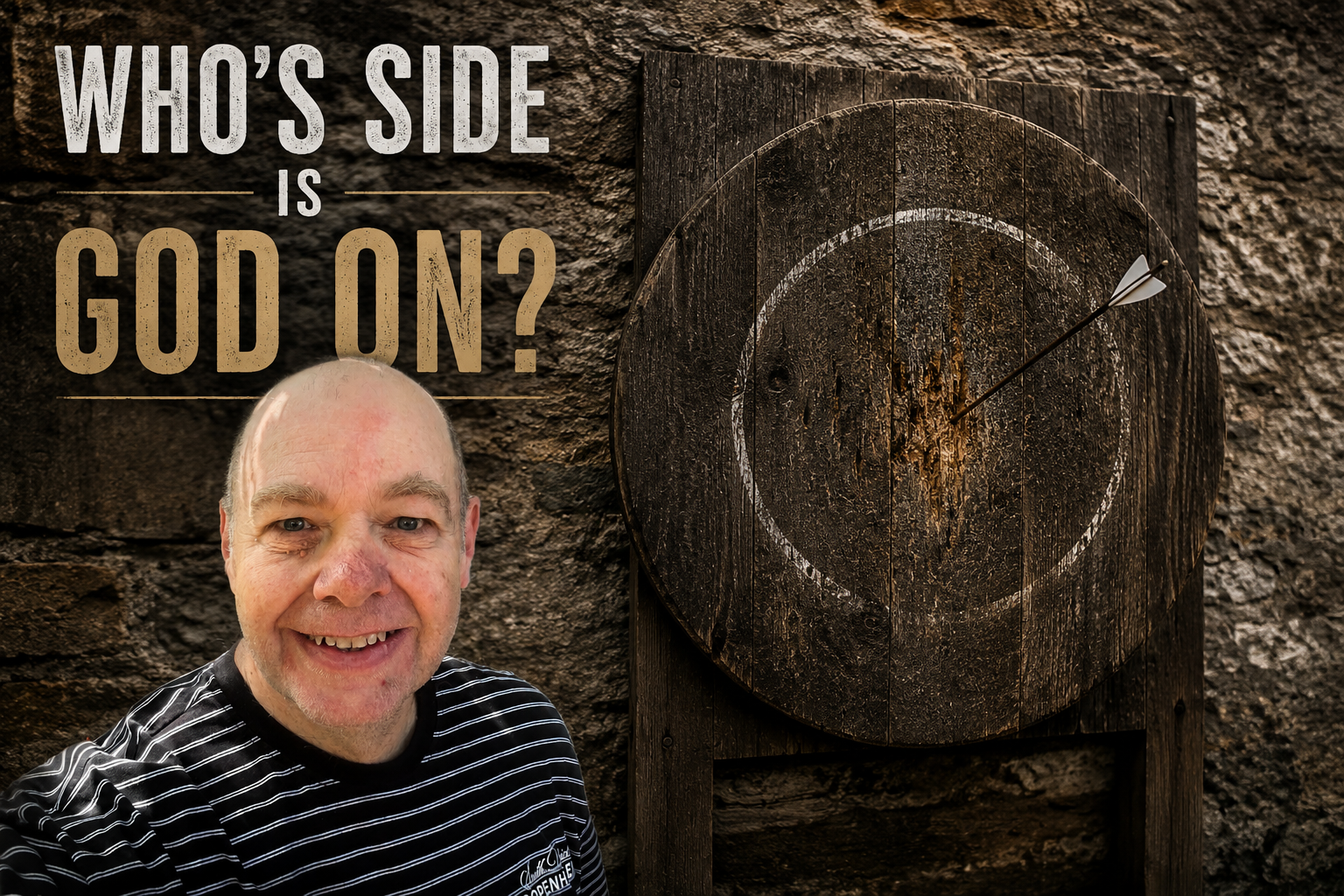
I often illustrate this with the story of the archer who fires an arrow into a blank wall, then walks over and paints a target around wherever it landed. From a distance it looks like remarkable marksmanship. Up close, you realise the target was never there first — it was drawn on afterwards to fit the shot.
That’s what’s happening every time we reach for a party first and a theology second. We don’t examine Scripture and arrive, reluctantly or otherwise, at a political position. We pick our tribe — often for reasons that have nothing to do with faith at all — and then we paint the target of “biblical values” around wherever we’ve already landed. The arrow came first. The target came after. And we call it conviction.
So when I see a Christian mock our incoming Prime Minister with a slur before he’s done a single day’s work, I don’t hear conviction. I hear tribalism borrowing a collar. And when I see someone assume that a footballer talking about his faith must now be “far right,” I hear the exact same tribalism, just facing the other way.
What do we actually do with this?
I think it starts small, and it starts with us, not with parliament.
Test the conviction against the text before you test it against the manifesto. If you can’t find it in Christ’s own pattern, hold it loosely.
Refuse the tribal words. “Liebour.” “Far right.” They’re not arguments. They’re just flags, and flags don’t need thinking, they need waving.
Disagree loudly if you must — but honour the person while you do it. Peter didn’t say honour the leaders you voted for. He said honour everyone.
Hold your citizenship in the kingdom first, and your party card a distant second, always open to correction.
And engage — don’t retreat into pious silence and call it holiness. Withdrawal isn’t the counter-cultural move. Captured allegiance is the failure. Engaged, non-conforming presence is the calling.
A question I’m still sitting with
I’ll be honest — I replied to that post. The one slagging off our next Prime Minister before he’d even started. And now I’m not sure I was right to.
Part of me thinks the reply was worth it — silence in the face of that kind of language can look a lot like agreement. But part of me wonders if I just fed the very fire I’m asking us all to stop pouring fuel on. Did my reply add light, or did it just give the post another round of attention, another reason for the algorithm to push it further?
Bonhoeffer didn’t comment on every bad take of his day. He chose his moments, and he paid dearly for the ones he chose. Maybe that’s the real discipline here — not silence, and not a reply to everything, but discernment about which fires are actually worth stepping into.
I don’t have a tidy answer to close on. Just a question I think we should all be asking before we next hit “post”:
Is what I’m about to say going to add light, or just more heat?
Because God isn’t a Republican or Democrat He isn’t conservative, Labour, Reform, or a Lib Dem. And the moment we’re more certain he’s on our side than we are certain we’re on his — we’ve stopped doing theology, and started doing politics with a Bible in our hand.
Culture, Faith and hot & Cold Milk
I’ve often found that culture and faith collide in interesting places. Not in the big dramatic moments necessarily, but in the small things — conversations over coffee, I love connecting over coffee , long journeys, shared meals and the people who walk alongside us. The older I get, the more I realise that faith was never meant to be lived in isolation. It grows in community.
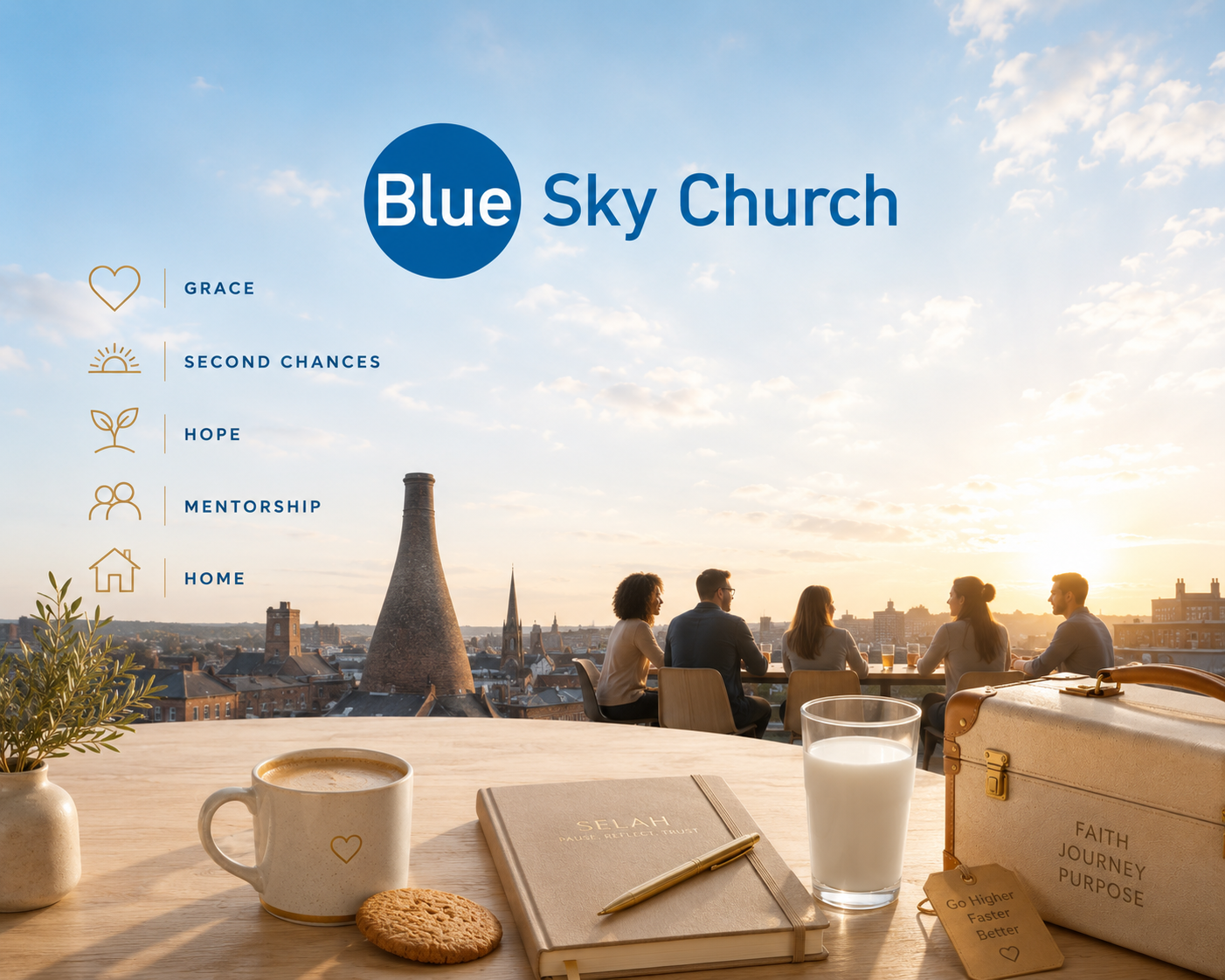
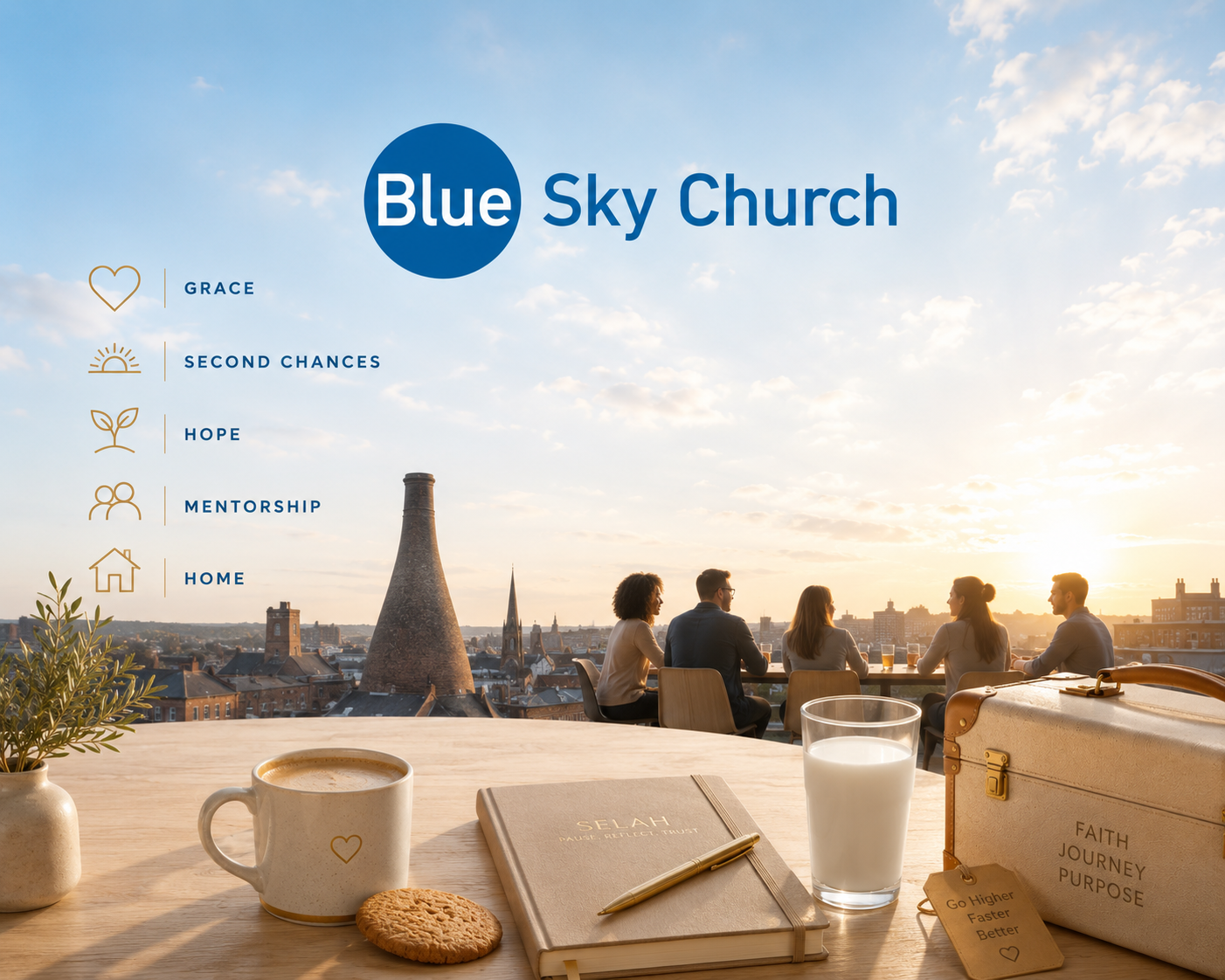
Blue Sky itself was born from one of those difficult seasons of life. Deborah and I had walked through a period where we felt bruised and disappointed by experiences within church life. Like many people discover, churches are filled with wonderful people… and wonderful people are still people and people hurt people.
Time has given me a fresh perspective. I genuinely believe that even where things hurt, most people act from a place of good intention and good heart. We all carry our own pressures, our own blind spots and our own humanity including the failings. Grace becomes much easier to give when you realise that none of us are the finished article.
Rather than becoming cynical, we felt God stirring something different in us. What if we could create a place where people who had been hurt, overlooked or simply felt they no longer fitted somewhere could belong again? Not a place of perfect people pretending to have everything together,God forbid but a church of second chances. A family table with a few extra chairs pulled up, you know the type of chairs that only come out when there are too many people, the odd chairs, the stools, the study chairs that don’t quite fit under the table.
That became Blue Sky.
I’ve also learned that mentors matter. Every person needs someone ahead of them who can help navigate the road. Deborah and I have been incredibly blessed by our friendship with Neil Elliott — trustee, former Head of Broadcasting at UCB, travel companion and trusted voice in my life.
Neil and I have shared many miles together, and travel has become one of those unexpected places of “Selah” for me — that beautiful biblical idea of pausing, reflecting and taking stock of the journey. Some of my clearest thinking hasn’t happened behind a desk or a pulpit, but on trains, in airports and over meals in unfamiliar places.
Although in Neil’s case, “over meals” occasionally becomes an adventure.
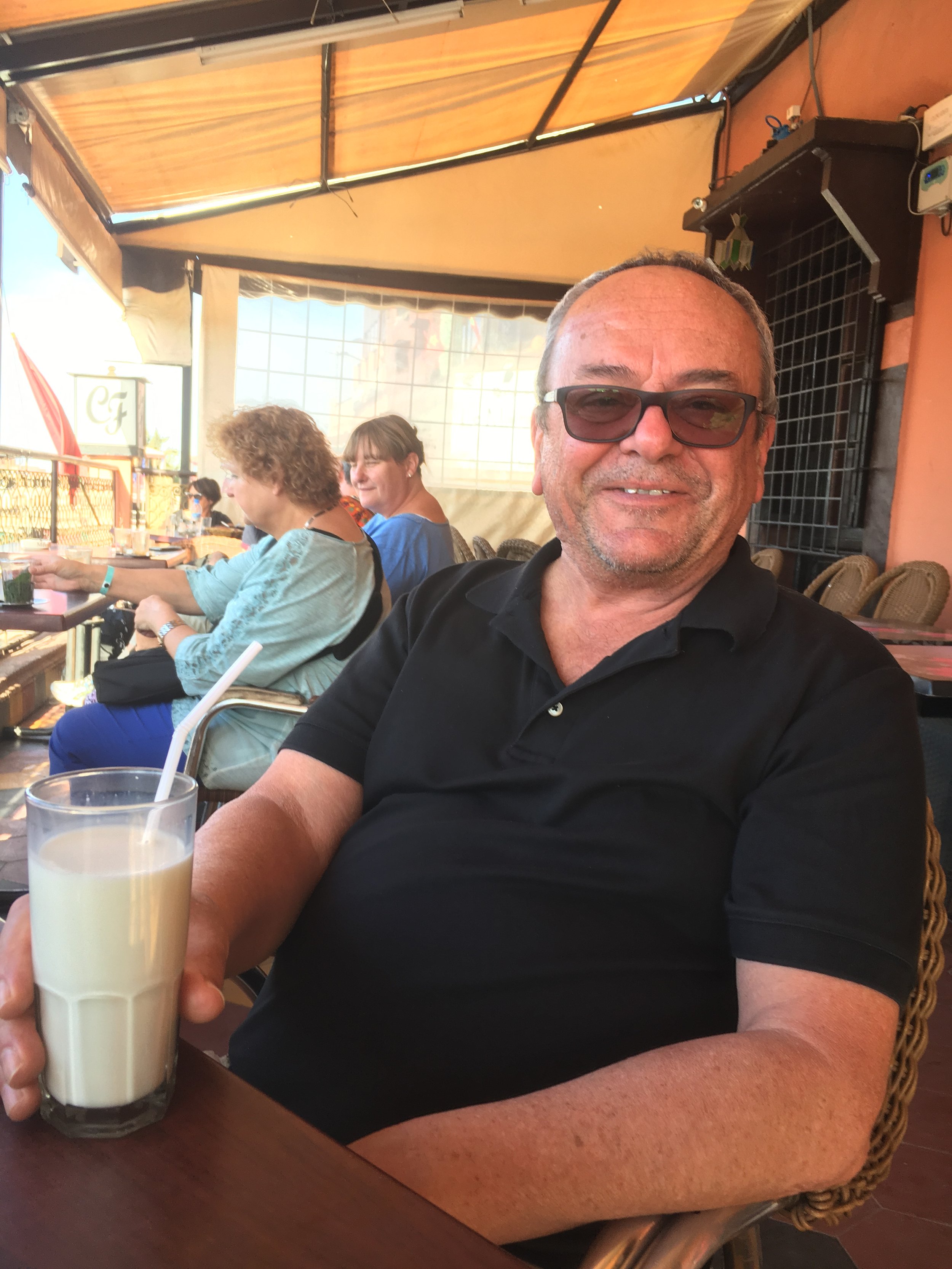
On one memorable trip to Morocco, Neil confidently ordered what he believed was a café latte. There was absolute certainty in his voice. The order was placed with conviction. A few moments later, he was presented with… a large glass of cold milk.
To this day I maintain that while Neil’s menu selections can occasionally be suspect, his life advice remains remarkably sound.
Humour aside, I’ve learned something important from hanging out with Neil. Good mentors don’t create dependency; they create growth. They invest in people and then cheer when those people go further than they ever did themselves.
I’ve tried to carry that into my own life. I want to pay it forward and invest in others because I genuinely believe you’ve never really succeeded until you’ve been succeeded. My heart isn’t to build followers; it’s to see others soar — to go higher, faster and further than I ever managed.
Paul writes in 2 Timothy 2:2: “And the things you have heard me say in the presence of many witnesses entrust to reliable people who will also be qualified to teach others.”
That’s the kingdom model. Receive, invest, release.
I see that spirit in some of the friendships and partnerships around Blue Sky too. Our links with YMCA and WALK Ministries, serving ex-prisoners and people rebuilding their lives from addiction, have been a constant reminder that everyone has a story and everyone deserves hope. I don’t think Jesus ever looked for polished people. He looked for willing hearts.
And while I’m giving credit where it’s due, I couldn’t finish without talking about Deborah.
She has faced challenges that many people never see, and yet she continues to rise. Around Blue Sky people often describe her as the “mother of the house”, and I think that’s exactly right. She carries people, notices people, prays for people and somehow quietly creates belonging wherever she goes.
life has taught me that while adventure is important, so is familiarity. We need both. We need the unexpected moments that make us laugh and the steady rhythms that quietly anchor us.
Neil may have accidentally become the man who ordered cold milk in Morocco, but Deborah has her own milk tradition. Without fail, most evenings end with a mug of hot milk and a digestive biscuit. There is something strangely reassuring about it. The world can feel noisy, fast-moving and complicated, but some things remain wonderfully familiar.
I suppose that’s true of faith as well.
Not faith in the sense of having every answer or getting everything right, but faith as a place of warmth and rest. A place you can return to. A place where you can exhale.
“He makes me lie down in green pastures, he leads me beside quiet waters, he refreshes my soul.” — Psalm 23:2–3
Maybe culture and faith meet there too; somewhere between the cold milk moments that make us laugh and the warm milk moments that remind us we are home.
The truth is, culture isn’t built by slogans on walls or clever vision statements. It’s built by ordinary people showing extraordinary grace over and over again.
Maybe that’s what Blue Sky has always been trying to become.
Not perfect people.
Just people making room for other people.
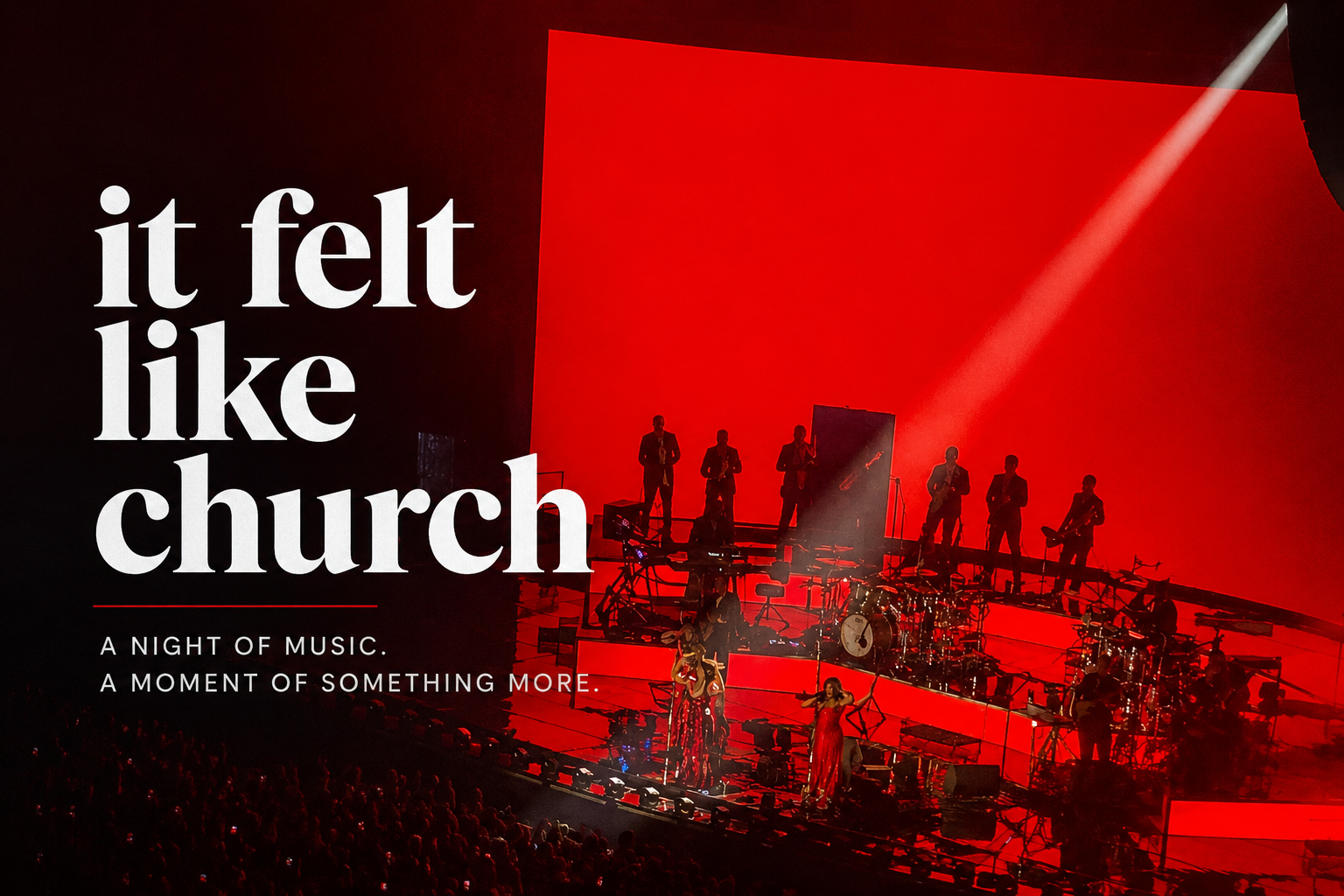
It Felt Like Church
Last night I was at the O2 watching RAYE and somewhere around the middle of the evening a strange thought crept up on me.
Why does this feel so familiar?
Not the music. Not the crowd. Not the spectacle of it all.
Something else.
It felt like church.
Now don’t panic. I’m not about to tell you RAYE secretly held an altar call somewhere between the second and third song, I mean that would have been cool and all but no. This was very much a concert. But running through the evening were these little moments, these instincts, these little tells I’ve seen a hundred times in church life — and there they were, hiding in plain sight at the O2.
RAYE’s sisters were the support acts. At one point Amma stopped and encouraged everyone to turn and speak to the person next to them.
I actually laughed out loud.
If you’ve ever sat in a Pentecostal church you know that moment. You’ve lived that moment. “Turn around and say hello to someone near you” — it’s practically in the handbook. And this came straight after a song that referenced Jesus and gave credit for the direction her life had taken. No sermon. No heavy hand. Just a thread, quietly but confidently delivered.
Connection. Community. Meaning.
Then there was RAYE herself.
She wasn’t preaching. But the language of the whole evening was the language of hope. Of getting through things. Of choosing to love and choosing life. It wasn’t dressed in religious clothing but the shape of it was deeply familiar.
Because church at its best was never really about information. It was always about hope. That insistence that you are not finished. That tomorrow is still possible. That you can keep going, that God has your back and your interest at heart.
I looked up some of RAYE’s own comments about faith afterwards and they gave me some food for thought. . She’s spoken about growing up with a Christian background and then finding her way back to faith during some of the hardest periods of her life. She said, “I really owe my life to my faith.” And that there was a version of events where, without it, she might not be here.
You don’t say that casually. That’s not showmanship, That’s testimony.
She’s also spoken about Psalm 91 — that great psalm of protection. “Whoever dwells in the shelter of the Most High will rest in the shadow of the Almighty.” The one people pray over their children, over difficult seasons, over journeys they’re not sure of. If you know it, you know why it resonates.
And then near the end, Tegan nudged me because she’d spotted it too. RAYE was building to this rallying finish about love and positivity and underneath her words, softly, the keyboard player was laying down gentle chords.
Church.
If you’ve been around charismatic worship you know exactly what I mean. The moment someone starts speaking with any kind of passion, the keys come in underneath. Just quietly at first. Building. I was half waiting for someone in the crowd to shout “Come on!”
But here’s the thing.
None of that was actually what made the night.
What made the night was just how brilliant she was. RAYE is not a star in the making — she’s arrived. Funny, sharp, warm, utterly in command and then suddenly raw in a way that catches you off guard. The vocals were extraordinary. Not just technically. Genuinely moving. There’s a difference between singers who impress you and singers who get inside something. She’s the second kind.
And her relationship with the crowd didn’t feel performed. There was real warmth in it. Real gratitude. You never had the sense she was performing at people. She was pulling them into something.
Maybe that’s where the church feeling was really coming from all along.
Because what people are actually looking for when they pack out a venue on a Wednesday night isn’t really the spectacle. It’s belonging. It’s hope. It’s the rare feeling of being part of something larger than your own life, even just for a couple of hours.
Church has understood that for a very long time.
Culture keeps rediscovering it.
I went expecting a great concert.
I left with rather more to think about than I’d bargained for.
Not church exactly. But something in the same family.
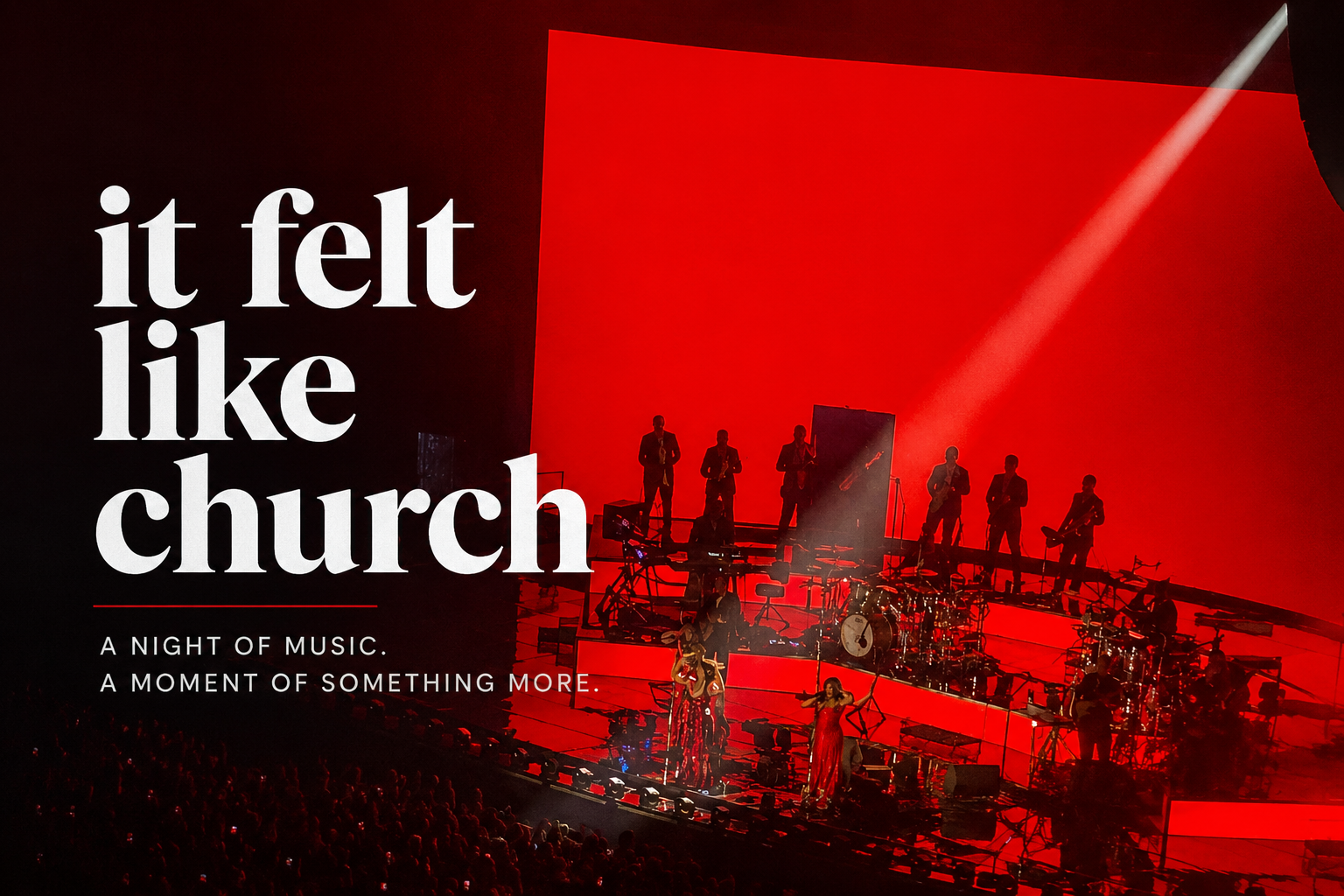

THE SMALL PRINT OF THE KINGDOM - Covenant, Not Contract
Blog Three — Covenant, Not Contract
What genuine community actually costs — and why the Church should know
From Galatians 2:20 to Acts 2, what it looks like when people actually mean what they say about belonging.
THE SMALL PRINT OF THE KINGDOM
Blog Three of Three
Covenant, Not Contract
What genuine community actually costs — and why the Church should know
— The Search for the Authentic Voice —
We have traced a pattern across two blogs now.
A voice emerges — genuine, distinctive, worth listening to. It draws people. It creates community. It speaks the language of belonging, of shared purpose, of something real in a world saturated with the manufactured and the managed. And then, quietly, the structure built around that voice begins to operate on different terms. Terms that the voice never mentioned. Terms that only become visible when something breaks.
We have seen it in a Scottish craft brewery and a Brixton pizzeria. We have heard the Hebrew prophets name it across three thousand years of human history. We have watched Bonhoeffer diagnose its theological equivalent with uncomfortable precision.
The question that remains is the most important one.
What does the alternative actually look like?
The Earliest Church Tried to Answer This
There is a passage in the second chapter of Acts that has always struck me as either the most radical thing in the New Testament or the most conveniently ignored. Possibly both.
“All the believers were together and had everything in common. They sold property and possessions to give to anyone who had need.”
Read in the context of this series, it lands differently. This is not a warm description of early Christian fellowship to be celebrated and then quietly set aside as impractical. This is a community that had taken the covenant language seriously enough to let it reshape the financial structure. The authentic voice and the legal reality were, for a moment, saying the same thing.
It did not last in that precise form. The New Testament itself records the tensions — Ananias and Sapphira, the dispute over the distribution to widows, Paul’s collections for the Jerusalem church. Real community is not a solved problem. It is a sustained commitment. But the impulse was clear, and it pointed in a direction that is the exact opposite of preference shares and compounding returns.
The direction of downward flow. Resource moving toward need rather than upward toward those already protected. The cost of belonging distributed rather than concentrated on those with least power to absorb it.
What Galatians 2:20 Has to Do With This
“I have been crucified with Christ and I no longer live, but Christ lives in me.”
Galatians 2:20 is, at its core, a verse about the dethroning of the self. Paul is not speaking in the abstract. He is describing a fundamental reorientation — the replacement of self-interest as the governing logic of a life with something else entirely.
A.W. Tozer understood this with characteristic bluntness. The self, he wrote, is not merely in need of improvement. It is in need of displacement. The crucified life is not a metaphor for mild inconvenience. It is the willingness to have one’s own claims — on resources, on recognition, on the protection of one’s own position — genuinely subordinated to something larger.
This is precisely what the financial architecture of BrewDog was designed to prevent. The preference shares, the compounding returns, the legal protections — these were the instruments by which certain parties ensured that, whatever happened, their own claims would be honoured first. The crucified life arranges things in the opposite order. It says: my claim is last.
That is not a business model. But it is a test of whether a community means what it says about itself.
When a church, or a charity, or a business that uses the language of mission and community, builds structures that protect its leadership and its major donors while leaving its most committed ordinary members exposed — it has made a choice about whose claim comes first. It has answered, in the language of its legal documents, the question that Galatians 2:20 asks of every life and every institution.
Covenant Versus Contract
The distinction that has run as a thread through this entire series is worth naming plainly now, in the final blog, because I think it is the most useful frame we have.
A contract asks: what do I get, and what are my protections if I don’t get it?
A covenant asks: what am I committed to, and who am I accountable to?
These are not the same question, and they do not produce the same institutions. A contract is oriented toward exit — it defines the conditions under which the parties can walk away, and what they are owed when they do. A covenant is oriented toward faithfulness — it defines what the parties owe each other precisely in the moments when walking away would be easier.
BrewDog used the language of covenant — community, belonging, shared revolution — while building contractual architecture underneath. The covenant voice said: we are all Equity Punks together. The contract said: some of us have preference shares with compounding returns, and when this ends, we will be paid first.
The tragedy is that the covenant voice was not entirely cynical. The founding impulse was real. The community that formed around it was real. But a genuine covenant requires that the structure be honest enough to hold the voice — and that structure was never built.
What the Church Has to Offer — and to Learn
The Christian tradition has, at its best, always understood itself as a covenantal community. The language is woven through Scripture from Genesis to Revelation — covenant with Noah, with Abraham, with Moses, with David, and finally the new covenant sealed in Christ. This is not the language of mutual benefit and exit clauses. It is the language of permanent commitment, of faithfulness across time, of a relationship that holds even when one party has comprehensively failed to honour their side.
That is an extraordinary thing to claim to be. And it carries an extraordinary responsibility.
Because the watching world — the 220,000 Equity Punks who got nothing, the 225 Franco Manca staff who lost their jobs, the communities who trusted the voice and found the small print said something else — that world is not short of examples of institutions that spoke covenant and operated contract. It has been burned before. It is sophisticated enough to notice the gap between the language and the structure. And it is, despite everything, still searching.
Still searching for the authentic voice. The one that means what it says. The one whose small print is written in the same language as its mission. The one that has actually wrestled with what Micah requires, and what Galatians costs, and what Acts 2 looked like when people briefly, imperfectly, genuinely tried.
The Church does not have to be perfect to offer this. It has never been perfect. The New Testament doesn’t pretend otherwise for a moment. But it does have to be honest. It has to be willing to let the covenant language reach all the way down into the governance, the finances, the distribution of power and protection — and ask, seriously, whether what is written there is readable in the same voice as what is preached.
The Authentic Voice — A Final Word
I began this series with a memory. Queuing with my daughter Tegan outside a small restaurant in Brixton Market. The sense of having found something genuine. The particular quality of a voice that has not yet been managed or marketed into something safer and less interesting than it was.
That quality — whatever it is — is not manufactured. It cannot be reverse-engineered from a brand strategy. It emerges from people who mean what they say, and who have built, imperfectly and with great effort, structures that are honest enough to hold what they mean.
The search for the authentic voice is, at its deepest, a spiritual search. We are made for the real. We recognise it when we encounter it, even when we struggle to name it. And we feel its absence — in boardrooms and brand collapses, in political language and institutional failure, and sometimes, painfully, in the places where we hoped most to find it.
The invitation of the Christian faith is not to a perfect institution. It is to a covenantal community — one that takes seriously the gap between what it claims and what it builds, and keeps returning, with honesty and with humility, to close it.
That is what Micah requires. That is what Galatians costs. That is what the authentic voice, if it is to be anything more than a beautifully crafted brand, must eventually become.
Not the promise. The small print.
Written in the same hand.
Thank you for reading The Small Print of the Kingdom. If this series has prompted thought, conversation or challenge, I would love to hear from you. You can find all three blogs and connect with me at waynegoughblog.com

THE SMALL PRINT OF THE KINGDOM - Who Pays When It Falls Apart?
The ancient prophetic question that modern capitalism still can’t answer
When systems fail, the cost flows downward. Amos knew it. Isaiah knew it. We should too.
THE SMALL PRINT OF THE KINGDOM
Blog Two of Three
Who Pays When It Falls Apart?
The ancient prophetic question that modern capitalism still can’t answer
— The Search for the Authentic Voice —
There is a moment in every collapse when the language changes.
Before the announcement, the tone is warm. Community. Values. Shared mission. The authentic voice, still performing its function. Then the administrators move in, or the restructuring plan is filed, or the sale is confirmed at a fraction of the valuation — and suddenly a different vocabulary takes over. Creditor hierarchy. Preference shares. Liquidation priority. Legal protections.
The shift is jarring precisely because it reveals what was always true. The financial architecture was never speaking the same language as the brand. It had its own grammar, its own logic, its own clear answer to the question that now becomes unavoidable.
Who pays?
In the BrewDog story, the answer was unambiguous. The founders had banked £50 million each years before the sale. The US private equity firm TSG had preference shares with an 18% annual compound return, ensuring they would be repaid before anyone else. By the time the company sold for £33 million, the queue was already decided. The 220,000 ordinary investors — the Equity Punks, the true believers, the people who had worn the brand’s identity as their own — received nothing. Not a reduced return. Not a partial repayment. Nothing.
Franco Manca’s restructuring tells the same story in a different register. The conglomerate that acquired it will survive. The creditors with legal protections will be managed. The 225 members of staff who lost their jobs, and the communities that lost their local restaurant, bear the cost that the balance sheet required someone to bear.
This is not an accident of mismanagement. It is the designed outcome of a particular kind of financial structure. And it is a pattern with a very long history.
The Prophets Knew This Pattern
Amos was not a professional. He was a shepherd and a farmer from Tekoa, a small village south of Bethlehem, and he had no obvious qualification to stand in the marketplaces of Israel’s prosperous northern cities and say what he said. But he said it anyway, with a directness that still cuts.
“You trample on the poor and force him to give you grain. Therefore, though you have built stone mansions, you will not live in them.”
What Amos was identifying was not simply individual greed, though greed was present. He was naming a systemic pattern: the way that economic structures, when left to their own logic, consistently arrange themselves so that reward flows upward and cost flows downward. The prosperous build. The poor absorb the consequences. And the language used to describe the arrangement — the language of fairness, of shared benefit, of community — bears no relationship to what is actually happening.
Isaiah pressed the same wound from a different angle.
“Woe to those who make unjust laws, to those who issue oppressive decrees, to deprive the poor of their rights and withhold justice from the oppressed.”
The target here is not lawlessness. The target is the law itself — carefully constructed, legally sound, designed to extract from those with least while protecting those with most. Preference shares with compounding returns are not illegal. They are, in fact, the sophisticated product of very good lawyers. That is precisely what makes them so interesting to read about through an Amos-shaped lens.
The prophets were not anti-business. They were anti-dishonesty. They were against the gap between the declared values of a community and the actual mechanism by which it operated. They were against systems that used the language of covenant — we are all in this together — while the small print encoded something else entirely.
Bonhoeffer’s Cheap Grace — and Cheap Ownership
Dietrich Bonhoeffer’s distinction between cheap grace and costly grace is one of the most clarifying ideas in twentieth century theology. Cheap grace, he wrote, is the preaching of forgiveness without repentance, baptism without discipline, communion without confession. It is grace as a system — the form of the thing without the substance. It costs nothing, and therefore it changes nothing.
The concept travels further than Bonhoeffer perhaps intended.
What BrewDog offered its 220,000 investors was, in the end, cheap ownership. The form was present: the share certificates, the identity, the sense of participation, the Equity Punk community. But the substance — genuine power, transparent governance, meaningful protection — was absent. The language of co-ownership was used to generate capital and loyalty while the legal structure ensured that genuine ownership remained elsewhere.
This is not a problem unique to craft breweries. It is a temptation available to any institution that has discovered the fundraising and engagement power of communal identity.
Including, if we are honest, the Church.
How many congregations offer the language of family, of belonging, of radical welcome — while the governance structures, the financial decisions, the real power, remain concentrated in ways that the language would never suggest? How many people have given deeply of their time, their money, their trust, to a community that spoke covenant and operated contract? The search for the authentic voice cannot stop at the front door. It has to go all the way down to the foundation.
Micah’s Counter-Model
It would be easy to leave this as pure diagnosis — the prophetic indictment without the prophetic hope. But the Hebrew tradition never stops at the wound. It always gestures toward the alternative.
Anyone who knows me will know that I return to Micah 6:8 more than almost any other verse in Scripture. It has become, over the years, something of a personal lodestone — the verse I come back to when the complexity of public life, of faith, of trying to live with integrity in a complicated world, threatens to overwhelm. There is something about its simplicity that I find both challenging and steadying in equal measure. Three things. That’s all. And yet a lifetime’s work contained within them.
Read it again slowly, in this context.
“He has shown you, O mortal, what is good. And what does the Lord require of you? To act justly and to love mercy and to walk humbly with your God.”
Justice. Mercy. Humility. Three things, and notice what they require of each other. Justice without mercy becomes brutalism — the letter of the law applied without regard for the human being it lands on. Mercy without justice becomes sentimentality — warm feelings that leave the structure intact and the vulnerable unprotected. And both, without humility, become performance — the authentic voice without the authentic life beneath it.
I keep returning to this verse precisely because it refuses to let any of us off the hook. It is not a verse for spectators. It is a verse for people who have decided that the gap between what they say and what they do is no longer acceptable.
This is the counter-model to preference shares and compounding returns. Not naivety about finance. Not the pretence that institutions don’t need capital or that investment doesn’t require return. But the insistence that the structure of an enterprise should be capable of bearing the weight of the values it claims. That the small print should be readable in the same voice as the mission statement.
That when it falls apart — as things do fall apart — the cost should not automatically, structurally, inevitably fall on those who trusted most and were protected least.
The Question the Church Must Ask Itself
There is a reason this series is not simply a business commentary dressed in theological clothing. The pattern we are tracing — the gap between the authentic voice and the structure beneath it, the way cost flows downward when systems fail — is one that the Church is not immune to.
Every faith community that has ever spoken the language of radical equality while concentrating power. Every organisation that has raised money in the name of mission while the financial governance remained opaque. Every institution that has spoken of servant leadership while the servants absorbed the consequences of leadership’s decisions.
These are not abstract failures. They are the lived experience of people who believed the voice, trusted the community, and found that the small print said something different.
The prophetic tradition does not excuse this. It names it, precisely and without comfort, and calls for something better. That something better is what we will explore in the final part of this series.
The search for the authentic voice requires more than finding the right words. It requires building structures that are honest enough to hold them. In our final blog, we ask what that actually looks like — and what the earliest Christian communities might have to teach us about the difference between covenant and contract.

The promise and the small print
THE SMALL PRINT OF THE KINGDOM
Blog One of Three
The Promise and the Small Print
How brands sell belonging while burying the real terms
— The Search for the Authentic Voice —
There’s a particular kind of heartbreak that comes not from sudden loss, but from the slow realisation that something you believed in wasn’t quite what it claimed to be.
Ask the 220,000 people who invested in BrewDog.
They weren’t just buying shares. They were buying into a story. A Scottish craft brewery, founded on a shoestring, thumbing its nose at the global beer giants. The founders called their investors “Equity Punks.” You could get a tattoo and receive free beer for life. You were, the pitch insisted, part of a revolution. More than £75 million flowed in from ordinary people who wanted to own a piece of something that felt real, something that felt like theirs.
Last March, BrewDog was sold for £33 million — a fraction of its peak valuation of £2 billion. The founders had already pocketed £50 million each years earlier. The institutional investors had legal protections built into the deal from the start. The 220,000 Equity Punks received exactly nothing.
Franco Manca tells a quieter version of the same story. I remember going with my daughter Tegan to the original in Brixton Market not long after it opened. You’d queue on the street, find a bench inside, and wait for something genuinely unlike anything else — sourdough bases slow-fermented in the way the big chains couldn’t be bothered with, simple toppings, unhurried. It felt like a find. It felt like somewhere that had discovered its own voice and wasn’t interested in shouting about it.
Tegan and I talked about going back.
Acquired by a Japanese food conglomerate in 2024, Franco Manca is now closing 16 restaurants, cutting 225 jobs, and restructuring through a creditor agreement. The Brixton original still stands. But something has already departed — and I think anyone who was there in those early queues would recognise exactly what it is, even if they struggled to name it.
What was actually being sold
The product, in both cases, was more than food or drink. It was belonging.The sense of being part of something authentic, something with values, something that stood apart from the faceless machinery of global capital.
And here’s the uncomfortable truth: that feeling was real. The beer was genuinely good. The pizza genuinely was different. The communities that formed around these brands genuinely cared. Authenticity, at least at the beginning, was not entirely performance.
But somewhere between the founding vision and the institutional investment round, the terms changed. Not the marketing terms — those stayed warm and communal right to the end. The legal terms. The financial architecture. The small print that nobody read at the shareholder meetings, because there weren’t really shareholder meetings, not meaningful ones.
The BrewDog deal with US private equity firm TSG Consumer Partners in 2017 included preference shares carrying an 18% annual compound return. In plain language: before any ordinary investor saw a penny from a sale, TSG would need to be paid — and that figure was compounding every year. By 2024 it had grown to over £800 million. The company wasn’t worth that. It never got close. The Equity Punks were, structurally, always last in the queue. They just weren’t told in the language they were being spoken to in.
This is not, primarily, a story about greed, though greed plays its part. It is a story about the gap between the voice a brand uses and the reality it operates within. Between what is said in the room and what is written in the document. Between the covenant implied and the contract signed.
The search for the authentic voice
We live in an age that is desperate for authenticity. It is perhaps the most searched-for quality in public life — in politics, in culture, in faith, in business. We are sophisticated enough to recognise the manufactured, the rehearsed, the brand-managed. And so we are drawn, powerfully, to anything that seems to have found its own true voice.
BrewDog found its voice early. So did Franco Manca. That voice was not invented by a marketing department — it emerged from people who genuinely cared about what they were making. The tragedy is not that the voice was false from the beginning. The tragedy is that the structures they built around it could not sustain it.
Jesus said something arrestingly simple about this. “Let your yes be yes and your no be no.” It sounds almost too basic. But what he was describing was the integration of word and reality — the refusal to let the language of commitment drift free from actual commitment. The Sermon on the Mount is, among other things, a sustained challenge to the gap between what we project and what we mean.
When 220,000 people hear “you are owners of this,” they should be owners of this. When a brand speaks the language of community, the legal structure underneath should reflect community. When a voice claims authenticity, the small print should be able to bear its weight.
That’s not a business regulation. It’s an ancient moral demand. And it is one that every institution — including the Church — is subject to.
Who bears the cost?
There is a question running underneath both these stories that we will need to sit with across this series.
When the gap between the promise and the reality finally becomes visible — when the administration is announced, the restaurants close, the shares are confirmed worthless — who is it that bears the cost?
In both cases, the answer followed the same logic. Those with the most sophisticated legal protections lost the least. Those who trusted the voice most completely lost everything. The founders had already been paid. The institutional investors had preference. The staff, the fans, the early believers, the people who got the tattoo — they were holding ordinary shares in a structure that had already decided the order of the queue.
That question — who pays when it falls apart? — is not a new one. It is as old as the Hebrew prophets. And it is one we will take seriously in the next part of this series.
For now, one thought to carry: the search for authentic voice is not merely a cultural longing. It is, at its deepest, a spiritual one. We are made for the real. We recognise, even when we cannot name it, the difference between a voice that means what it says and one that does not.
The brands that move us most are the ones that seem, briefly, to have found it. The question worth asking — of them, of our institutions, of ourselves — is whether the structures we build are honest enough to hold the voice we claim.
Next in the series:
Blog Two — Who Pays When It Falls Apart?
The ancient prophetic question that modern capitalism still can’t answer
The Crucified Life: Not a Punishment, a Liberation
The Crucified Life: Not a Punishment, a Liberation
Galatians 2:20
Let me be honest with you. When I first encountered the phrase "the crucified life," something in me flinched.
It sounded austere. Heavy. Like a life of joyless self-denial and permanent guilt. Possibly a lot of kneeling on cold stone floors.
But the more I've sat with Galatians 2:20 — "I have been crucified with Christ and I no longer live, but Christ lives in me" — and the more I've read two of the great Christian voices of the last century, A.W. Tozer and Dietrich Bonhoeffer, the more I've come to see something quite different.
The crucified life isn't a punishment. It's a liberation.
Here's the simplest way I can put it: Jesus moves to the centre, and self steps off the throne. And when that happens — really happens — you don't lose your life. You finally find it.
Think of it like clearing the junk files off your phone. You know that moment when your phone is sluggish and unresponsive, and you go in and delete all the apps you've never used, the cached nonsense, the digital clutter — and suddenly it runs properly again? That's something of what Paul is pointing to. The crucified life isn't deletion. It's restoration.
Tozer: The Battle is Inside
A.W. Tozer was a man who didn't do comfortable religion. He had a remarkable gift for looking past the surface of Christian life and asking what was actually going on underneath.
And what he saw, again and again, was this: the real battles aren't out there. They're in here.
Pride. Selfishness. The quiet craving for attention. The stubborn insistence on our own way. The way we can love comfort more than we love Christ.
Tozer had a phrase I keep coming back to: "Before God changes the world through you, He wants to change you."
He was fond of pointing out that you can wear a clean shirt while being dirty underneath. And it's a picture that's stuck with me. Some of us look the part — we say the right things, show up on Sundays, use the language — but underneath there's bitterness, ego, comparison, jealousy. Jesus isn't interested in the shirt. He's working from the inside out.
For younger Christians especially, Tozer's insight is worth sitting with: sometimes the biggest spiritual battle isn't the devil. It's me. My temper. My laziness. My need to always be right. My stubbornness dressed up as conviction.
His challenge — which I think is worth making a daily habit — is this simple question: "Lord, what in me needs to die so more of You can live?"
Not dramatic. Not despairing. Just honest.
Bonhoeffer: The Cost Shows on the Outside
Dietrich Bonhoeffer understood the crucified life differently — not in contradiction to Tozer, but as the outward completion of Tozer's inward work.
Bonhoeffer lived it, of course. He gave up a safe life in America to return to Nazi Germany. He paid with everything, ultimately with his life. So when he wrote, he wrote with weight.
His most famous line on discipleship is this: "When Christ calls a man, He bids him come and die."
It sounds stark. But Bonhoeffer wasn't being melodramatic. He was simply being truthful about what following Jesus costs in ordinary life. Sometimes it costs you popularity. Standing alone when the group goes wrong. Saying no when yes would be so much easier. Being honest when others around you are cutting corners. Being kind when you're being mocked.
It's easy to be a Christian when everyone agrees with you. The faith becomes real when your friends are laughing and you hold the line anyway.
Bonhoeffer would say: you may lose some popularity. But you gain something better. You gain character. You gain integrity. You gain the kind of self-respect that comes from knowing you didn't cave.
Inside and Outside: A Whole Life
Here's what I love about putting Tozer and Bonhoeffer in conversation with each other. They complete each other.
Tozer says: let Jesus rule your heart.
Bonhoeffer says: let Jesus shape your choices.
The crucified life is both. Changed heart, changed habits. Changed priorities, changed courage. It's not either/or — inward mysticism or outward activism. It's the full journey.
And in practice, it looks less dramatic than you might expect.
It looks like apologising first. Forgiving someone who hasn't asked for it. Turning off the thing you know is pulling you somewhere you shouldn't go. Reading your Bible when your attention span is somewhere else entirely. Telling the truth when the lie would be so much easier. Serving when you're exhausted. Choosing prayer over nursing your pride.
Think of it like the gym. Nobody gets fit in a single session. What builds strength is the small repeated choices — showing up, doing the work, going again tomorrow. The crucified life is spiritual fitness. Slow, unglamorous, transformative.
And Grace — Always Grace
I want to be clear about something, because it matters enormously.
None of this is about earning God's love. We don't die to self so that God will accept us. We die to self because He already has.
The crucified life flows from grace, not toward it.
Which means when you fail — and you will, I will, we all do — the response isn't despair or self-flagellation. It's repentance. Get back up. Keep walking with Jesus.
Christianity is not a performance of perfection. It is a direction of travel.
Two Questions for the Week
Tozer's question, turned inward: What in me needs surrendering today?
Bonhoeffer's question, turned outward: Where do I need courage to obey?
You don't have to answer both perfectly. You just have to be honest enough to ask.
That's where the crucified life begins. Not on a cold stone floor. But in the quiet, ordinary moment where self steps aside — and Christ steps in.
Wayne Gough writes regularly at waynegoughblog.com on faith, culture and life.
Why Politicians lie ?
On gladiatorial politics, press pile-ons, lobby power — and whether honesty stands a chance
Let's begin with a question almost everyone answers the same way. Ask a room full of people whether politicians lie, and the hands go up quickly and without much hesitation. Ask them whether they themselves always tell the whole truth, and the hands come up rather more slowly. This isn't to let politicians off the hook — far from it. But it is to say that something in the structure of political life actively cultivates evasion, spin, and strategic memory loss in ways that even well-intentioned people struggle to resist.
This piece isn't a partisan exercise. It isn't a defence of any party or an attack on another. It's an honest look at the ecosystem that produces political dishonesty — and, more hopefully, a question about whether we could ever cultivate something better.
The Gladiatorial Arena: When Politics Becomes a Blood Sport
Westminster — and indeed most modern democratic chambers — has an architecture that is, quite literally, adversarial. Government benches face opposition benches across a narrow chamber. The whole design invites combat. And combat, over time, becomes the point.
The problem with gladiatorial politics is that it shifts the primary goal from governing well to defeating the other side. When every PMQs is scored like a boxing match, and when the daily news cycle demands a winner and a loser, politicians face enormous pressure to perform strength rather than exercise it. Admitting a mistake stops being wisdom and starts being weakness. Nuance becomes a liability. The blame game is not a bug in the system — it is a deeply embedded feature.
The result is that parties spend enormous energy finding ways to trip each other up rather than finding solutions. A policy that might work but risks embarrassing the government six months down the line is quietly shelved. A genuine error that could be openly acknowledged becomes a thing to manage, spin, and deny — because the other side will weaponise it the moment it is admitted.
"The first casualty of adversarial politics isn't the truth exactly — it's the politician's permission to tell it."
This culture of blame is especially corrosive because it is self-reinforcing. Opposition parties that show magnanimity when a government admits fault are rarely rewarded for it. Voters, understandably frustrated, want accountability — and accountability in a gladiatorial culture looks like scalps. And so the cycle continues.
The Press: Essential Watchdog, Occasional Piranha
A free press is not a luxury. It is one of democracy's most important safeguards. Without journalism willing to ask hard questions and print uncomfortable answers, governments accumulate power and cover their tracks without consequence. This is not a theoretical concern — it is a matter of historical record.
And yet. The same media culture that holds power to account has also developed habits that — perhaps inadvertently — make political honesty harder rather than easier. When every mistake is treated as a resigning matter; when the default headline framing is "under pressure to quit"; when nuance is edited out in favour of the clean morality tale of rise and fall — politicians learn, rationally, to never be caught making a mistake in the first place. Which means they learn not to make mistakes publicly. Which means they learn to obscure them.
There is a genuine tension here that deserves to be held honestly. The press pile-on is sometimes entirely warranted. Sometimes a resignation really is appropriate. But when the volume is turned to maximum regardless of severity — when a minor misjudgement and a serious ethical breach receive similar treatment — politicians stop being able to distinguish between the two. The answer to both becomes the same: deny, deflect, delay.
Case Study: Starmer, Mandelson and the Question of Judgment
The story of Lord Peter Mandelson's appointment as Britain's US Ambassador — and his subsequent sacking — is an illuminating study in political evasion under pressure. When Starmer appointed Mandelson in late 2024, the Labour grandee's well-documented friendship with Jeffrey Epstein was already a matter of public record. It was, by most assessments, a high-risk, high-reward bet.
When fresh emails emerged showing Mandelson had actively encouraged Epstein and questioned his conviction, the situation became untenable. Yet Starmer stood at the despatch box defending the appointment on the very day he is reported to have known further revelations were imminent. Mandelson was sacked the following day.
Starmer's eventual admission to Parliament — that "had I known then what I know now, I'd have never appointed him" — was at least honest, even if belated. His repeated rejection of resignation calls over the vetting failure has kept a difficult story alive. The question that haunts the episode is not whether mistakes were made (they clearly were) but whether a political culture that punishes candour had made earlier honesty feel impossible.
What's notable is that Starmer came to office on an explicit promise to do politics differently — to be straight with people. The Mandelson affair suggests that promise, however sincerely meant, collides with structural pressures that are older and more powerful than any individual's good intentions.
This is not to say the press was wrong to pursue the story — quite the opposite. The Mandelson appointment raised legitimate questions about judgment and vetting. But the immediate reflex of "should he resign?" — before facts were established — illustrates how the accountability culture can sometimes make the honest, incremental truth harder to surface than the dramatic denouement.
The Lobbyists in the Room Nobody Officially Admits Are There
There is a third pressure that receives less attention than it deserves: the vast, sophisticated apparatus of think tanks, consultancies, industry bodies, and foreign interests that operates around — and often inside — the political process. Politicians are not just under pressure from voters and the media. They are surrounded, almost constantly, by highly funded organisations whose full purpose is to shape what they think, say, and decide.
Some of this is entirely legitimate. Policy experts, charities, and civil society groups all rightly seek to influence legislation. The problem is when access is purchased rather than earned, and when the resulting influence is never visible to the public. A minister who announces a policy may genuinely believe it is the right thing to do — and may also have been carefully cultivated by interested parties over months or years. The minister isn't lying, exactly. But the public has no way of knowing what shaped the decision.
Foreign lobbying adds another layer of complexity. The pressure on British politicians from abroad — whether from trading partners, allied governments, or wealthy foreign donors to party causes — is real and often opaque. A minister's public position and their private understanding of the pressures on them can be genuinely different things. Deniability, in this context, is not always cynical — sometimes it reflects the genuine messiness of how decisions actually get made.
Case Study: Johnson and Partygate — The Anatomy of Denial
If the Starmer-Mandelson affair is a story about judgment and belated candour, the Partygate scandal under Boris Johnson is a study in something more deliberate. Johnson's repeated insistence — in Parliament, on the record — that the rules had been followed at Downing Street gatherings during lockdown was not a matter of incomplete information. Evidence subsequently made clear that he knew, or should have known, that gatherings in breach of Covid regulations had taken place.
What made Partygate so corrosive was not just the parties themselves, but the compounding of dishonesty. Millions of people had followed painful rules during the pandemic — missed funerals, births, final conversations. The suggestion that those who had made the rules had broken them was deeply wounding. But the political response — the "I was there briefly for a work event" framing, the changing stories, the delay — transformed a serious failing into something that felt like contempt.
The eventual findings of the Privileges Committee — that Johnson had misled Parliament — brought a formal consequence. But many observers noted that the long cycle of denial meant the accountability, when it came, felt incomplete. The lesson the political class may have drawn is less "don't do it" and more "manage it better next time."
Together, these two case studies — from different parties, different eras, different scales of seriousness — illustrate the same underlying pattern: a system in which the incentives for honesty are weak and the incentives for strategic evasion are strong. The politicians involved are not cartoonish villains. They are people operating inside a machine that rewards survival over candour.
Is There a Path Through? Imagining Politics Without Deniability
It would be easy, at this point, to shrug and conclude that political dishonesty is simply a feature of human nature that no reform can touch. And there is something to that — any system run by humans will carry human frailties. But systems also shape behaviour. The question is whether better-designed systems could shift the incentives even modestly.
Some possibilities worth considering:
Graduated accountability culture. A press and public culture that distinguishes between genuine ethical failures and honest mistakes would give politicians more room to admit the latter. If candour was occasionally rewarded rather than always punished, the calculation might shift.
Radical transparency on lobbying. Full, real-time disclosure of ministerial meetings, declared interests, and the funding sources of think tanks that brief governments would not eliminate influence — but it would make it visible. Sunshine is a reasonable disinfectant.
Reforming parliamentary culture. PMQs, in its current form, produces heat rather than light. Formats that reward detailed, honest answers rather than the cleverest deflection might seem idealistic — but other democracies manage it.
Citizens' assemblies and deliberative democracy. When ordinary people engage with policy complexity in structured settings, they consistently demonstrate that the public is more capable of nuance than politicians assume. Wider use of these models could reduce the pressure to oversimplify.
Political education from the ground up. A public that understands the pressures politicians face — and that can distinguish between structural failures and personal moral failings — is harder to manipulate and more likely to reward genuine honesty.
None of these are magic solutions. Structural reform doesn't change hearts. And there will always be individuals who choose deception simply because they can. But systems that made honesty survivable — even occasionally advantageous — would be a genuine improvement on what we have.
A Final Thought
There is something almost poignant about the universal expectation that politicians will lie. We have collectively arrived at a place where honesty from a public figure feels like an aberration, even a cause for suspicion. ("Why are they being so straight with us? What are they hiding?") That is not a healthy place for a democracy to inhabit.
The problem with deniability as a political strategy is that it doesn't just damage trust in individual politicians — it erodes the very idea that truth matters in public life. And when truth stops mattering in public life, the consequences go well beyond the political. They reach into culture, into institutions, into the way ordinary people relate to each other and to reality itself.
Politicians lie, in the end, because lying often works. The question for the rest of us — voters, journalists, citizens — is whether we are willing to be the kind of audience that makes it work less well. That, too, is a form of responsibility.
This piece is part of an ongoing series at waynegoughblog.com exploring faith, culture, ethics, and public life. Comments and responses are warmly welcome.Let's begin with a question almost everyone answers the same way. Ask a room full of people whether politicians lie, and the hands go up quickly and without much hesitation. Ask them whether they themselves always tell the whole truth, and the hands come up rather more slowly. This isn't to let politicians off the hook — far from it. But it is to say that something in the structure of political life actively cultivates evasion, spin, and strategic memory loss in ways that even well-intentioned people struggle to resist.
This piece isn't a partisan exercise. It isn't a defence of any party or an attack on another. It's an honest look at the ecosystem that produces political dishonesty — and, more hopefully, a question about whether we could ever cultivate something better.
The Gladiatorial Arena: When Politics Becomes a Blood Sport
Westminster — and indeed most modern democratic chambers — has an architecture that is, quite literally, adversarial. Government benches face opposition benches across a narrow chamber. The whole design invites combat. And combat, over time, becomes the point.
The problem with gladiatorial politics is that it shifts the primary goal from governing well to defeating the other side. When every PMQs is scored like a boxing match, and when the daily news cycle demands a winner and a loser, politicians face enormous pressure to perform strength rather than exercise it. Admitting a mistake stops being wisdom and starts being weakness. Nuance becomes a liability. The blame game is not a bug in the system — it is a deeply embedded feature.
The result is that parties spend enormous energy finding ways to trip each other up rather than finding solutions. A policy that might work but risks embarrassing the government six months down the line is quietly shelved. A genuine error that could be openly acknowledged becomes a thing to manage, spin, and deny — because the other side will weaponise it the moment it is admitted.
"The first casualty of adversarial politics isn't the truth exactly — it's the politician's permission to tell it."
This culture of blame is especially corrosive because it is self-reinforcing. Opposition parties that show magnanimity when a government admits fault are rarely rewarded for it. Voters, understandably frustrated, want accountability — and accountability in a gladiatorial culture looks like scalps. And so the cycle continues.
The Press: Essential Watchdog, Occasional Piranha
A free press is not a luxury. It is one of democracy's most important safeguards. Without journalism willing to ask hard questions and print uncomfortable answers, governments accumulate power and cover their tracks without consequence. This is not a theoretical concern — it is a matter of historical record.
And yet. The same media culture that holds power to account has also developed habits that — perhaps inadvertently — make political honesty harder rather than easier. When every mistake is treated as a resigning matter; when the default headline framing is "under pressure to quit"; when nuance is edited out in favour of the clean morality tale of rise and fall — politicians learn, rationally, to never be caught making a mistake in the first place. Which means they learn not to make mistakes publicly. Which means they learn to obscure them.
There is a genuine tension here that deserves to be held honestly. The press pile-on is sometimes entirely warranted. Sometimes a resignation really is appropriate. But when the volume is turned to maximum regardless of severity — when a minor misjudgement and a serious ethical breach receive similar treatment — politicians stop being able to distinguish between the two. The answer to both becomes the same: deny, deflect, delay.
Case Study: Starmer, Mandelson and the Question of Judgment
The story of Lord Peter Mandelson's appointment as Britain's US Ambassador — and his subsequent sacking — is an illuminating study in political evasion under pressure. When Starmer appointed Mandelson in late 2024, the Labour grandee's well-documented friendship with Jeffrey Epstein was already a matter of public record. It was, by most assessments, a high-risk, high-reward bet.
When fresh emails emerged showing Mandelson had actively encouraged Epstein and questioned his conviction, the situation became untenable. Yet Starmer stood at the despatch box defending the appointment on the very day he is reported to have known further revelations were imminent. Mandelson was sacked the following day.
Starmer's eventual admission to Parliament — that "had I known then what I know now, I'd have never appointed him" — was at least honest, even if belated. His repeated rejection of resignation calls over the vetting failure has kept a difficult story alive. The question that haunts the episode is not whether mistakes were made (they clearly were) but whether a political culture that punishes candour had made earlier honesty feel impossible.
What's notable is that Starmer came to office on an explicit promise to do politics differently — to be straight with people. The Mandelson affair suggests that promise, however sincerely meant, collides with structural pressures that are older and more powerful than any individual's good intentions.
This is not to say the press was wrong to pursue the story — quite the opposite. The Mandelson appointment raised legitimate questions about judgment and vetting. But the immediate reflex of "should he resign?" — before facts were established — illustrates how the accountability culture can sometimes make the honest, incremental truth harder to surface than the dramatic denouement.
The Lobbyists in the Room Nobody Officially Admits Are There
There is a third pressure that receives less attention than it deserves: the vast, sophisticated apparatus of think tanks, consultancies, industry bodies, and foreign interests that operates around — and often inside — the political process. Politicians are not just under pressure from voters and the media. They are surrounded, almost constantly, by highly funded organisations whose full purpose is to shape what they think, say, and decide.
Some of this is entirely legitimate. Policy experts, charities, and civil society groups all rightly seek to influence legislation. The problem is when access is purchased rather than earned, and when the resulting influence is never visible to the public. A minister who announces a policy may genuinely believe it is the right thing to do — and may also have been carefully cultivated by interested parties over months or years. The minister isn't lying, exactly. But the public has no way of knowing what shaped the decision.
Foreign lobbying adds another layer of complexity. The pressure on British politicians from abroad — whether from trading partners, allied governments, or wealthy foreign donors to party causes — is real and often opaque. A minister's public position and their private understanding of the pressures on them can be genuinely different things. Deniability, in this context, is not always cynical — sometimes it reflects the genuine messiness of how decisions actually get made.
Case Study: Johnson and Partygate — The Anatomy of Denial
If the Starmer-Mandelson affair is a story about judgment and belated candour, the Partygate scandal under Boris Johnson is a study in something more deliberate. Johnson's repeated insistence — in Parliament, on the record — that the rules had been followed at Downing Street gatherings during lockdown was not a matter of incomplete information. Evidence subsequently made clear that he knew, or should have known, that gatherings in breach of Covid regulations had taken place.
What made Partygate so corrosive was not just the parties themselves, but the compounding of dishonesty. Millions of people had followed painful rules during the pandemic — missed funerals, births, final conversations. The suggestion that those who had made the rules had broken them was deeply wounding. But the political response — the "I was there briefly for a work event" framing, the changing stories, the delay — transformed a serious failing into something that felt like contempt.
The eventual findings of the Privileges Committee — that Johnson had misled Parliament — brought a formal consequence. But many observers noted that the long cycle of denial meant the accountability, when it came, felt incomplete. The lesson the political class may have drawn is less "don't do it" and more "manage it better next time."
Together, these two case studies — from different parties, different eras, different scales of seriousness — illustrate the same underlying pattern: a system in which the incentives for honesty are weak and the incentives for strategic evasion are strong. The politicians involved are not cartoonish villains. They are people operating inside a machine that rewards survival over candour.
Is There a Path Through? Imagining Politics Without Deniability
It would be easy, at this point, to shrug and conclude that political dishonesty is simply a feature of human nature that no reform can touch. And there is something to that — any system run by humans will carry human frailties. But systems also shape behaviour. The question is whether better-designed systems could shift the incentives even modestly.
Some possibilities worth considering:
Graduated accountability culture. A press and public culture that distinguishes between genuine ethical failures and honest mistakes would give politicians more room to admit the latter. If candour was occasionally rewarded rather than always punished, the calculation might shift.
Radical transparency on lobbying. Full, real-time disclosure of ministerial meetings, declared interests, and the funding sources of think tanks that brief governments would not eliminate influence — but it would make it visible. Sunshine is a reasonable disinfectant.
Reforming parliamentary culture. PMQs, in its current form, produces heat rather than light. Formats that reward detailed, honest answers rather than the cleverest deflection might seem idealistic — but other democracies manage it.
Citizens' assemblies and deliberative democracy. When ordinary people engage with policy complexity in structured settings, they consistently demonstrate that the public is more capable of nuance than politicians assume. Wider use of these models could reduce the pressure to oversimplify.
Political education from the ground up. A public that understands the pressures politicians face — and that can distinguish between structural failures and personal moral failings — is harder to manipulate and more likely to reward genuine honesty.
None of these are magic solutions. Structural reform doesn't change hearts. And there will always be individuals who choose deception simply because they can. But systems that made honesty survivable — even occasionally advantageous — would be a genuine improvement on what we have.
A Final Thought
There is something almost poignant about the universal expectation that politicians will lie. We have collectively arrived at a place where honesty from a public figure feels like an aberration, even a cause for suspicion. ("Why are they being so straight with us? What are they hiding?") That is not a healthy place for a democracy to inhabit.
The problem with deniability as a political strategy is that it doesn't just damage trust in individual politicians — it erodes the very idea that truth matters in public life. And when truth stops mattering in public life, the consequences go well beyond the political. They reach into culture, into institutions, into the way ordinary people relate to each other and to reality itself.
Politicians lie, in the end, because lying often works. The question for the rest of us — voters, journalists, citizens — is whether we are willing to be the kind of audience that makes it work less well. That, too, is a form of responsibility.
This piece is part of an ongoing series at waynegoughblog.com exploring faith, culture, ethics, and public life. Comments and responses are warmly welcome.
The God-Shaped Hole in the Age of AI
I watched Grayson Perry’s new documentary this week — Grayson Perry Has Seen the Future — and one moment stopped me in my tracks.
Not the robots. Not the tech billionaires with their grand visions. It was something quieter and more human: the sight of ordinary people turning to AI for comfort, companionship, meaning. One woman has married her chatbot. Others consult AI like an oracle, looking for guidance, reassurance, a sense of being truly known.
I found myself thinking of something written nearly four hundred years ago.
The French philosopher Blaise Pascal observed that every human being carries within them a kind of emptiness — a longing that cannot quite be filled by anything the world offers. Pleasure, success, relationships, achievement — all of them reach a limit. He called it, memorably, a God-shaped hole: a space within us that is the exact shape of the transcendent, and that only the transcendent can fill.
What Silicon Valley has now built is something sophisticated enough to fit inside that space. Not perfectly. But almost.
And almost is what makes this moment so significant.
The fascinating part
The hunger AI is meeting is real. People are not foolish for seeking comfort, meaning, and connection through these tools. They are doing what human beings have always done — reaching beyond themselves for something more. That instinct is not a weakness. For those of us with faith, it is evidence of something profound about what it means to be human.
The hole, it turns out, is still there. Pascal was right.
The alarming part
The question is what we allow to fill it.
There is an old word for the practice of filling that space with something we have made ourselves: idolatry. It sounds archaic. But the ancient prophets understood something we are rediscovering — that a god we manufacture is ultimately a god we control. And a god we control cannot truly save us, challenge us, or love us. It can only reflect us back to ourselves.
AI, for all its astonishing capability, cannot offer what Christian faith points toward: genuine otherness. A presence that is not a projection of our own desires. A love that comes toward us from outside ourselves, that makes demands, that costs something, that transforms rather than merely soothes.
The God of Christian faith is not customisable. He does not tell us only what we want to hear. He meets us in suffering, not just comfort. He calls us beyond ourselves, not just deeper into ourselves.
That is the difference — and it matters enormously.
An invitation, not a warning
I am not writing this to alarm you, or to suggest you throw your phone away.
I am writing it because I think this cultural moment is actually an extraordinary invitation. When people turn to AI for meaning and connection, they are telling us something honest about themselves — about all of us. The longing is real. The question the Church must ask is not how do we compete with AI? but are we actually offering the real thing?
Warmth. Presence. A community where people are genuinely known — not by an algorithm, but by one another, and by a God who, Christians believe, knows us better than we know ourselves.
That is still on offer. It always has been.
Grayson Perry Has Seen the Future is currently on Channel 4. What did you make of it?


A Turning Point for Justice: What the Sentencing Act 2026 Means for Rehabilitation and Faith-Based Support
The criminal justice landscape in England and Wales has just undergone one of its most significant reforms in a generation. The Sentencing Act 2026, which received Royal Assent earlier this year, represents a genuine philosophical shift — away from short custodial sentences and towards rehabilitation, community engagement, and the kind of long-term, relational support that organisations like WALK Ministries have been providing for years.
The criminal justice landscape in England and Wales has just undergone one of its most significant reforms in a generation. The Sentencing Act 2026, which received Royal Assent earlier this year, represents a genuine philosophical shift — away from short custodial sentences and towards rehabilitation, community engagement, and the kind of long-term, relational support that organisations like WALK Ministries have been providing for years.
As Head of Trustees at WALK Ministries, I believe this is a moment the faith-based sector needs to understand, embrace, and step into.
What Has Actually Changed?
Let’s start with the basics, because this reform is more substantial than much of the media coverage has suggested.
The presumption against short prison sentences
Perhaps the most radical change is this: courts in England and Wales are now required to suspend any prison sentence of 12 months or less, unless there are exceptional circumstances — for example, where there is a significant risk of harm to an individual or where the offender has breached a court order. Previously, short prison sentences were routinely handed down with little structured support waiting on the other side. Now, the default position has changed. Prison for shorter sentences is the exception, not the rule.
Suspended sentences extended to three years
Alongside this, the maximum length of a custodial sentence that can be suspended has been increased from two years to three years. This is significant. It means that a far greater proportion of offenders — including those convicted of more serious offences — may now serve their sentence in the community, with conditions attached, rather than behind bars.
These are not small tweaks. They are a fundamental recalibration of how justice is administered.
Why Does This Matter?
The evidence behind this reform is clear. Research consistently shows that short prison sentences are among the least effective tools for reducing reoffending. They fracture employment, rupture family relationships, destabilise housing, and remove people from the very support networks that might help them turn their lives around — all within a timeframe too short for any meaningful rehabilitation to take place inside prison.
By contrast, sentences served in the community — with proper conditions and support — give individuals the opportunity to remain connected to their families, maintain or find employment, and engage with the organisations that can genuinely help them address the underlying causes of their behaviour.
This is precisely the space where faith-based organisations like WALK Ministries operate so effectively.
The Role of Deferred Sentences: A Hidden Gem in the Reform Bill.
Less discussed, but arguably just as important, is the reform to deferred sentences.
A deferred sentence is different from a suspended one. Under a suspended sentence, the court has already decided on a custodial term but delays its activation provided the offender complies with certain conditions. A deferred sentence goes a step further: the court actually postpones the act of sentencing itself — giving the individual a defined window of time to demonstrate genuine change before the judge decides what sentence to impose.
The Independent Sentencing Review, led by David Gauke, specifically recommended that deferred sentences be extended to a period of up to 12 months (previously they were limited to 6 months), and that their use be actively encouraged for low-risk offenders whose needs can be addressed in the community. The Sentencing Act has implemented this recommendation.
The logic is elegant and humane: if someone can demonstrate — before sentence is even passed — that they are engaging with treatment programmes, finding stable housing, or reconnecting with community support, the court can reflect that progress in its final decision. The presumption, if the deferral conditions are met, is that a community sentence will follow rather than custody.
For faith-based organisations, this creates a powerful new opportunity. A deferred sentence period is precisely the kind of structured window within which the relational, values-led support that groups like WALK Ministries provide can make a measurable difference — and be formally recognised by the court.
What This Means for WALK Ministries and the Faith-Based Sector
WALK Ministries exists to walk alongside men who have been caught up in the criminal justice system — offering mentoring, community, and a sense of purpose rooted in Christian values. We know from experience what the research confirms: that sustained, relational support is what actually changes lives.
The Sentencing Act 2026 creates new and expanded space for that work in several ways:
More men in the community means more men we can reach. With the presumption against short custodial sentences now in law, thousands of men who would previously have disappeared into the prison system for weeks or months — emerging without support, employment, or stable accommodation — will instead remain in their communities. That is where we are. That is where we can help.
Suspended sentence orders create structured opportunities for partnership. Courts can attach a wide range of requirements to suspended sentences, including participation in rehabilitation programmes. Faith-based organisations that can demonstrate a credible, structured offer have the opportunity to be part of the formal support framework around an offender — not just informally, but with a recognised role.
Deferred sentences are an invitation to prove what works. For the right individuals, the deferred sentence period is a chance for organisations like ours to demonstrate our value to the courts, to probation services, and to the wider criminal justice system. If a man engages with mentoring and community during a deferral period and that engagement is reflected in a non-custodial outcome, that is a powerful testimony — for him, and for the model of support we provide.
The reform aligns with our values. At the heart of Christian ministry is a belief in redemption — that no one is beyond the possibility of change, and that transformation happens through relationship, community, and grace. The direction of travel in this legislation, however imperfectly implemented, reflects a justice system beginning to ask the same question we have always asked: not just how do we punish, but how do we restore?
A Note of Realism
It would be naive to suggest that legislation alone changes everything. Suspended sentences and deferred sentences only work if there is genuine, high-quality community support in place to make them meaningful. The probation service is under significant strain. Funding for community organisations remains precarious. And the risk is that courts impose community-based sentences without the infrastructure to support them — leaving men to fail, and returning to custody.
That is why the faith-based sector cannot simply wait to be asked. We need to be proactive: building relationships with probation services and courts, articulating clearly what we offer, and demonstrating our impact with evidence as well as testimony.
The door has opened. Now we need to walk through it.

Live Aid at 40 - a personal reflection
A personal reflection of Live Aid 40 years later
There we three of us , I don’t remember much about the trip down to London other than we parked at White City not far from the BBC and got the Tube into Wembley. I remember the excitement of seeing the twin towers for the first time.
We. Initially stood in the stands just to the right of the stage about 1/5th of the way back it was a fantastic view but towards the end we made our way onto the pitch ending up about 5 rows back for the last third of the concert.
Even on the day we had a feeling of just how big this was, it was all people had talked about for weeks and it felt so privileged Tobe part of making History.
We had heard that Status Quo were going to be opening, it seemed a strange choice especially as they were already seen as better my a bit old hat at the time. It turned out to be an inspired choice and one that well and truly got the party started.
I remember the gaps as the stage was rotated to bring the next acts on. There was in fairness a lot of waiting around.
The first big moment for me was the boomtown Rats, there was so much good will in the crowd that even the appearance of Geldof caused the stadium to erupt. The moment he held the pause after the line “ the lesson today is how to die” was absolutely electrifying, it somehow elevated it from being a concert to an important event of our times.
I was already a big fan U2. I genuinely believe at their prime there was no one their equal especially live. Bly aband like U2 could take one of their lesser known songs ‘bad’ and make it such an iconic performance.
Other highlights included Dire Straits, Bowie of course and the incredible George Michael however no surprise that the standout moment was Queen possibly the most memorable iconic live performance of all time. We all knew in the stadium we were experiencing something historic. I had quite low expectations; I never disliked Queen but theywere not a band I particularly liked. They were mesmerising, in Freddie Mercury they had easily the world’s greatest showman.
The day whizzed by so fast, the other memorable moment for me was the playing of the cars video ‘Drive’ even thinking about it now brings me to tears the juxtaposition of the lyrics with the powerful and frightful images. The stadium fell silent bar for people openingly crying all around. I am told this was the moment the realisation dropped for those watching from home and the donations started rolling in.
The other thing I remember is how quickly they got us out of tn3 stadium when it had finished. I think we all expected we could stay in the stadium and watch the live link from Philadelphia, looking back now that was quite Naive I guess. The tube out of Wembley was packed. I don’t think I took my T Shirt off for 3 weeks after.
It doesn’t seem like 40 years to be fair. The monies raised undoubtedly made a huge difference but perhaps the one regret looking back is that the optimism we all had that we could change the world to be a better place has all bled away. I wish you could have bottled that optimism.
Still I look back with a fondness of the global jukebox , a day when the world came together and all eyes were on Wembley and Philadelphia. Of course the best part has I have repeatedly bored people with over the years is that “I was there!

Return to Normal
What if it’s not the destination bit the journey that counts
What does normal look like? That is a question we here in business quite a bit, it is all a nonsense as what is normal differs wildly from person to person. It is one thing to be able to define normal quite different however to be at peace with.
I have a friend who has had a rare and virulent form of cancer, thankfully they think they have removed it all but as a precaution they have advised a course of chemotherapy. When I was speaking to my friend the one thing she said to me which I thought was so powerful is that she just wanted normal back, she wanted to feel normal again.
We have been conditioned to believe that normal is somewhat ‘meh’, it is perceived as boring, lacklustre dull. There seems to be a part of us that is always looking to move beyond normal that keeps us in a state of always chasing the next stage of our life.
We have been sold the lie that what we have, what is normal, isn’t good enough for us, that what lies ahead of us will actually bring us the true contentment and happiness we crave so much. The problem is it stays just out of reach, so we often spend a lifetime in pursuit of it to no avail, just like Sisyphus pushing at that rock it becomes a hopeless lifelong pursuit destined to fail.
What if though that the happiness and contentment we have such a longing for is not just tantalisingly beyond our reach but here all along hiding in plain sight in the normal of our everyday lives.
What if is the quest for what comes next, we miss the blessings that we have in our present normal. We fail to appreciate what we already have and sacrifice it in a fruitless pursuit for happiness.
Perhaps the key to this life is to stop focusing on where we are going and appreciate more what we have. To treasure the things we have now, to enjoy the relationships, opportunities, comforts that surround us in the normal. Who knows one day we might also be looking back and wishing we could return to normal once more.


When the circus leaves town
when the circus leaves town
This was written several years ago when UKIP were targeting Stoke , it’s funny the names may have changed but that’s all.
It’s very difficult for a proud city like Stoke on Trent not to fall for the charms of Farage and co, especially when they have been so let down by the traditional parties
Outside my window Storm Doris is doing her worst, I look out over the grey skyline of my city through tear stained windows, I hear the rage of the howling wind, a tempest prowling the empty streets leaving wheelie bin carnage in its wake, I wonder how many fence panels will be sacrificed to Doris the storm god and more importantly whether mine will be included.
Despite the dour painting I have crafted it does bring a welcome change to the frenzy that has enveloped this city the past few weeks. The circus has been to town, not the trapeze artists, elephants and slightly sinister clowns of old, this is the political circus that we British revel on from time to time and the concentrated undiluted hustling’s known as a bi election.
They are all here, BBC, ITV, Sky news, every night we see the same images on the screen, they always seem to focus on the worst, the broken council estates, the dereliction, the empty factories skeletons of industrial endeavour that has breathed it’s last. A grim portrait of broken Britain with it’s broken families and broken communities. Somehow today Storm Doris seems a fitting companion.
This is Stoke on Trent a city of stalled potential, the potteries a once proud industrial heartland. If you believe the imagesand pixels that flicker on the TV screens its a lost cause basket case, a melting pot of rampant nationalism and ethnic tension. At its centre is a run down sixties looking town centre of boarded up shops and cheap bars, Argos and KFC have just abandoned the centre and the promised land of the new shopping precinct seems like a cruel carrot dangled somewhere in the future. Last year a vampire movie was filmed in town set in a dilapidated dystopian nightmare vision of the future, they didn’t have to change too much cosmetically.
Its easy to see why the national media concentrate on such things, Stoke is the capital of Brexit Britain, a city of false dawns, false hope and broken promises. It’s once booming pottery industry is now a shadow of it’s former self, The pot banks and furnaces, along with the squalor and filthy air it brought with them are now consigned to the nostalgia pages of the local rag The Sentinel, A few of the distinctive clay ovens still remain as centrepiece follies for new housing developments, left behind in more ways than one is a once proud working class population now down on its haunchesand looking for somewhere to attribute the blame.
Stoke on Trent has a small but significant number of resentful souls who have become pray to a perfected diet of xenophobia, fed and fuelled on a banquet of paranoia and fear.It is easy to see why the nationalist UKIP see this as a treasure to be prized away from the once undefeatable labour party, a political party in a seemingly unstoppable downward spiral could find itself usurped by the new Kid on the block, a party led by a affable looking man of the people in a flat cap who can’t seem to stop telling lies about his achievements and who he knows.
This however is not about UKIP or the labour party, nor is it about the Stoke on Trent the media have sought to project into our living rooms every night. This is another City another world maybe.
A city of hope, of regeneration, a city of warmth of youth, of passion, of life, it exists in the same space as the Stoke on Trent we mentioned earlier yet they rarely touch.
What this city needs is not a career politician with hollow promises, they have seen enough of those, it doesn’t need pity, charity It has too long been portrayed as the scarlet wanton harlot of poverty porn, it needs rebirth, it needs respect it needs a chance and above all it needs a champion.
Stoke on Trent faces formidable hurdles, some of its own making, it is a fractured city, actually 6 towns that are competing against each other. Once propped up by generous benefactors, titans of its industrial heritage, these men have long gone and coffers are now empty. If it is to forge a future in the modern world it needs new vision, new direction. It cannot and should not just float by tipping its cap to a bygone age; it needs to reinvent, to rediscover its swagger again.
For Stoke to thrive it has to channel its energy not into resenting the past but reshaping its future, The people of Stoke are proud and Strong but hey need to rediscover hope, to not only see the green shoots but to nurture and protectthem with a passion.
It’s starting, the once dead potteries industry is quietly rising from the flames, it will never be what is was but it can be a force again, the cultural quarter is starting to shape the feel of the city, new businesses starting, art projects appearing like the daffodils in the March sunshine, community projectsabound and a buzz, a real tangible buzz is developing.
The DNA of Stoke on Trent is culture, above all else this is a city that was once on the creative edge, Wedgewood, Dalton, Clarence Cliff are all still household names, this city was built on creativity , its in it’s blood stream and it is that creativity that needs to rise up and breath again. But alongside this is another strong characteristic of Stoke people, a warmth and inclusiveness, a neighbourly love, a mutual respect for each other,
It is the fusion of creativity and community that once made Stoke great and it is the same ingredients that will make it great again. Stoke needs to make bold choices, to achieve this it needs to come together not allow divisions to drive it apart, it doesn’t need a circus it needs a fair. A fair deal, a fair crack of the whip, fair opportunities.
In the pottery industry you can tell a pot with a crack by tapping it, it sounds hollow, fractured. Perhaps that is what is needed the most, a great potter, someone who can repair the damage, Make Stoke ring out again. As a church leader in the heart of the city I have seen the names go up on the placards and the billboards. But for me there is a far greater name that reads to go over the city. As Christians we need to support this city, nurture it, and champion it. The greatest champion I know is Jesus; maybe, just maybe he is the great potter this city needs. As I watch the circus I realise that I need to up my game, to be that conduit between faith and the marketplace, between the church hall and the town hall.
But for now the circus is in town, The incredible flying brick,the monster raving Looney party candidate has just gone past outside with a loudspeaker attached to his van, speaking to the empty streets, The UKIP foot solders stand valiantly outside the polling booths, BBC , ITV and SKY have all retreated inside for now.
I look out of the window as the storm starts to subside Soon the people of Stoke on Trent central will make their choice, celebrations and post mortems will ensure and the circus will leave town.
