The Distinguished Gentleman’s Guide to Modern Air Travel
*A Tenerife Diary*
-----
A Plane Full of Lads
Sometimes I have very dark thoughts. So dark, in fact, that I have to push them into the furthest, least visited corners of my mind.
I don’t think I have ever been on a worse flight than this one. Somehow, we have managed to board a plane occupied by a very large group of lads from what I can only assume is some sort of football organisation. I say lads — we are actually talking about men. Mostly balding men in their late thirties to early forties. Loud, leery, sexist men. Men who smell of cheap aftershave and stale beer. Hugo Boss and Lacoste hoodies: the uniform of choice. Terrace wear, I believe they call it. Men who, in all honesty, should know better. But don’t.
Which brings me to my dark thoughts. Would it be wrong, I pondered silently, to pray for this plane to fall from the sky? Would it, I wondered, be a noble act to sacrifice my own life if it meant taking the rest of these God-awful poor excuses for men with me?
Of course, I then began the inevitable journey of self-chastisement. That still, small voice — nagging, annoyingly accurate — chips in with the painful truth that Jesus died for these very people I am gleefully imagining having an appointment with the Lord rather sooner than planned.
It’s a conundrum, for sure. One made worse by my better half — my far better half — reminding me that crashing is actually her worst fear. I am also reminded, gently, that I am required to pray for people I don’t like as much as those I do. I have always found this grossly unfair. If I could have any job in the Kingdom, I’d like to be a virtue assessor — a sort of heavenly Sorting Hat, directing souls accordingly. But apparently that position is taken.
-----
Praying for Donald
The good ole boys and gals of the American evangelical establishment have been laying hands on Donald Trump in the Oval Office again. I will resist the obvious joke — it’s a cheap shot, akin to shooting ducks in a barrel.
But I do struggle with Trump and his association with the Christian right. Perhaps it’s my British sensibilities. I’m sure the optics play well to vast swathes of conservative America, but this side of the pond it lands very differently.
I have a feeling history won’t be especially kind to the President. Though I have many friends who hold him in high regard, and that itself creates a deeper problem for me.
In recent years I’ve had to reconcile the fact that I no longer fit comfortably within either the Christian right or the Christian left. My faith has, metaphorically speaking, fallen between the sofa cushions — mixing with the fluff, a loose 50p, and an odd hair clip. I wish I could simply take the best of both factions and jettison the nonsense. But then I’d have to face the rather uncomfortable question of who exactly I am to decide what counts as nonsense.
So I remain adrift. Lost at sea. Which for any Christian is troubling — but for a pastor, it’s downright worrying.
I keep reminding myself to hold on to whatever is true, whatever is just, whatever is noble. But some days my knuckles are white from the effort of gripping so tight.
DC Talk once asked: *What if I stumble, what if I fall? What if I lose my faith and make fools of us all?*
The answer, of course, is that his love is unconditional. I know it. And I find real solace in that unequivocal fact. But the struggle is real. Thank you, Donald.
-----
The Evil Hippie
Apparently, I am everything that is wrong with this country. I know this as a fact because an evil hippie told me so.
I realise I need to unpack that statement — context, as always, being everything.
It was 5:30 in the morning. Deb and I were quietly minding our business in the airport security queue when the aforementioned evil hippie — dressed in the kind of rustic, natural hessian attire I have always associated with the more benevolent wing of the counterculture — began complaining loudly about the speed of the security staff. Her irritation escalated rapidly. The blaspheming grew louder. And she kept looking at me, apparently expecting solidarity.
At this point — and I will freely admit that at 5:30am I was not thinking entirely clearly — I may have gently suggested that she perhaps shouldn’t be blaming Jesus. After all, as far as I could see, he had no direct involvement in the security scanning process whatsoever.
The look she gave me could have curdled milk. The comment that followed was brisk and devastating: *“You are everything that is wrong with this country.”*
That is, by any measure, quite a statement. Quite a weight to carry. My very first thought — I kid you not — was that it was absolutely going on my social media bio.
I briefly wondered whether my godly spiritual aura had somehow triggered her Wiccan sensibilities. I settled, more reasonably, on the conclusion that it was stupid o’clock in the morning and even hippies get grouchy. Though I suspect she was simply an evil one.
The next hour waiting for our gate was helpfully filled by a quietly entertaining game of spot-the-evil-hippie in the departure lounge.
-----
Finding Jesus in a Modern, Mixed-Up World
The real draw of those eleven days, beyond the departure lounge diversions, was the prospect of genuine rest. Not just a recharge — something a bit deeper. Time to look at my story. To examine the narrative my inner monologue has been telling me.
How do you find Jesus in a world that seems to have gone thoroughly, comprehensively bonkers? How do you realign, refocus? How do you find truth in the madness?
I wasn’t entirely sure. But I had eleven days to try.
-----
The Portland Frog
One of the most effective ways to disarm power is to satirise it. I was listening to a podcast in which the host described the Portland Frog Incident.
A man called Seth Todd began attending anti-ICE protests in Portland, Oregon, dressed in a green inflatable frog costume he’d bought online for about thirty dollars. The authorities, in their infinite wisdom, decided this warranted a response — and video footage went viral of officers spraying pepper spray directly into the ventilation slot of a frog suit.
The frog became the symbol of absurd resistance. People started turning up to protests in inflatable costumes of every description. The police became a laughing stock. I will admit, I quite enjoyed that.
It’s a perfect illustration of the contrast between the machinery of state power and the deflationary force of satire. The podcast also cited the idea that the best comedy is prophecy — a notion I don’t entirely agree with, but I can see where it’s coming from.
It made me think about my own preaching style. I’ve always tried to use humour and contemporary cultural reference to carry complex theological ideas — to wrap the message in something accessible so it actually lands. I sometimes wonder whether people perceive that as lacking depth. Perhaps that’s just vanity on my part. Perhaps not.
-----
Shame vs Guilt
There is something unexpectedly cathartic about listening to podcasts beside a swimming pool. Today’s subject is one I’ve been turning over in my mind for a while.
Much of my ministry in recent years has been built around two groups of people: those who have become disillusioned with church, and those in need of a genuine second chance — which perhaps explains my involvement with WALK Ministries, working primarily with ex-offenders and those in recovery from addiction.
A theme that comes up repeatedly is guilt. Not shame — guilt. The podcast made a distinction I found genuinely useful. Shame, properly understood, is a healthy and necessary emotion. It functions as a brake on our more basic impulses. The problem comes when shame metastasises into guilt. That, to me, is the crux of the redemption story: Jesus, in his act of love at the cross, took our guilt. And with it, the residual shame. To feel shame is natural. To dwell on it and allow it to calcify into guilt — that is where it becomes destructive.
Which brings me, inevitably, to breakfast.
We were quietly reprimanded today by the owner of the hotel restaurant. For the past few days, Deb and I had been taking a small selection of breakfast items back to our room to enjoy on the balcony. We had observed others doing the same, which gave us a degree of moral cover. Being called out while others apparently continued unpunished was, I’ll admit, a little galling. But it was a fair cop.
I won’t allow guilt to enter in. We will of course be compliant from this point forward — that’s simply in our nature. I will, however, be conducting a small silent protest by eating considerably more at breakfast. Not because he told us off — he was actually quite sensitive about it — but because of the way he speaks to his staff. That’s the telling detail, for me. I’ve always thought it important to treat everyone with basic courtesy and respect. The way a person speaks to waiters and service staff is one of the clearest indicators of character I know.
-----
An Englishman, a Welshman and a Scotsman Walk into a Bar
On my way out to get milk, I passed one of the many bars that litter the pavements of Los Cristianos, each one full of beer-bellied Brits nursing pints of Carling in front of enormous screens showing Premier League football.
This weekend, there’s been some variety — either the Cheltenham Gold Cup or the climax of the Six Nations, depending on where you looked. The rugby has, if I’m honest, rather passed me by this year. Mainly through choice. The persistent joy of watching Wales being dismantled every single week is something I decided to give a miss to in 2025.
It was at one particular bar — Jocks Bar, though other identical establishments are available — that I spotted, sitting in a line against the wall and engrossed in the sporting spectacle, three men: one in a Scottish rugby top, one in a Welsh jersey, and one in the white of England. I should note that they appeared to have arrived together. I’ll leave the punchline to your imagination.
-----
Low-Flying Planes
There is something about low-flying planes that has always fascinated me. From childhood trips to the St Athan airshow with my grandfather, to living in Stockton beneath the main flight path of Teesside Airport — something that most people would consider a nuisance, I absolutely loved.
I remember my first visit to what would become our home for five years — my first venture out of South Wales into exile in England — sitting in a rooftop café bar in Norton, asking God for a sign about whether it was right to uproot and move. At that precise moment, a plane flew low directly over our heads. I took that as a sign. In fairness, it wasn’t a bad move. Teesside gets a bad press, but it was a genuinely lovely place to live. We made good friends and I learned a great deal about church.
For all my love of aviation, I didn’t actually fly until I was married. Our first flight was a short hop from Cardiff to Prestwick, just outside Glasgow. It was bittersweet — for me, one of the most exciting moments of my life; for Deb, the discovery that she was afraid of flying. To her enormous credit, she hadn’t mentioned it beforehand. She didn’t want to spoil it for me.
We’ve been on many flights since. The fear and the excitement have both diminished somewhat, though neither has entirely gone.
Sitting on the balcony of our slightly sketchy hotel, out of nowhere came two biplanes — the kind that take tourists on sightseeing trips — flying incredibly low over our heads. They went around four times in total. I was fairly confident this wasn’t a message from God, and rather more likely connected to the week-long carnival taking place down in Los Cristianos, which we had arrived slap in the middle of entirely by happy coincidence. It did, however, generate over five hundred views on Instagram. So not all was lost.
-----
Carnival Time
The carnival in Los Cristianos was a spectacle well worth arriving for.
The day before it reached its climax, I joined the crowds lining the main street for the grand parade. One moment of unintended comedy occurred when the drums began and the crowd stirred with anticipation — only for a troupe of Hare Krishna devotees to appear round the corner. In fairness, they were sonically excellent, though they appeared to be drawing largely from the George Harrison back catalogue.
The main parade followed shortly after and did not disappoint. Colour, razzmatazz, and banging drums. From the very young to the very old, it seemed as though the entire town had turned out and taken to the street. The theme this year was space: glitter, sequins, Star Trek, Buzz Lightyear, ET cycling past on a BMX, and, for balance, not one but two Darth Vaders. There was also a slightly bewildering moment when three individuals walked by in what appeared to be Nazi stormtrooper uniforms, drawing a creased, uncomfortable stare from the largely British crowd. I moved on quickly.
It reminded me of the carnivals in Risca, my home town in the South Wales Valleys, when I was a child. I remember them as enormous, endless things — float after float rolling by for what felt like hours.
By the 1980s, those carnivals had become shadows of themselves. Risca was powered by two industries: coal and steel. The estate of Ty Sign, built into the hillside above the town, existed specifically to house workers from the nearby Llanwern steelworks — then the largest in Europe. When the pits closed and the steel trade declined, the valleys were devastated. The working men’s clubs and institutes that had grown out of those trades began to disappear. Some were saved: Oakdale Institute was dismantled and relocated brick by brick to the Museum of Welsh Life. Others, like the one in Crosskeys, were simply pulled down.
The Working Men’s Club in Risca survives to this day, though it is no longer the heart of the community it once was. By the late 1980s, the name felt like an oxymoron: a Working Men’s Club full of the unemployed, drinking down their giro cheques, trying to recall better times. The carnival, which the club had once anchored, diminished alongside it. I remember one year it consisted of a single float, a brass band, and two people dressed as characters from The Dukes of Hazzard.
The parade in Los Cristianos showed no such signs of fatigue. It went on and on — I never did see the end of it.
-----
The Funeral of a Fish
The conclusion of the carnival involves, for reasons I have yet to fully establish, a funeral procession and the ceremonial burning of a fish.
Not a real fish — a symbolic sardine, around six feet high and fifteen feet long, paraded through the streets by men dressed as mourners in black dresses before being committed to a funeral pyre. It is worth noting that this was not a solemn occasion. A DJ blasted out Latin American beats while the mourners danced with considerable enthusiasm around the doomed symbolic sardine. Eventually, it was time for the fish to depart on its fateful journey, and for Deb and me to depart for our hotel room.
And with that, the carnival was over.
-----
Getting Old (A Note on Three Young Girls)
One brief aside from the carnival. I noticed three young girls dancing enthusiastically in front of the soon-to-be-immolated fish, clearly enjoying themselves.
My first thought was: it’s Monday night — surely these children have school in the morning. Where are the parents?
The next minute I noticed they were drinking cocktails and smoking.
That is the precise moment I understood just how old I am.
-----
The Lonely Existence of the Holiday Pub Singer
There is absolutely no shortage of bars in Tenerife — mostly English and Irish — and in almost every one, a seemingly endless parade of pub singers. Some specialise in a single artist: Dean does Rod Stewart, Dawn does Tina Turner. Others work by era or genre. Stacy only does party anthems.
I found myself wondering: where do all these singers come from? I imagine they once had genuine dreams of making it in the business they call show. Now they spend their Thursday evenings working through the S Club 7 catalogue for rowdy beer-bellied lads and lasses in knock-off Hugo Boss.
The opening track on the Manic Street Preachers’ *Everything Must Go* — one of the last songs written by the late, great Richey Edwards — is called *Elvis Impersonator: Blackpool Pier*. It captures exactly this feeling. The quiet dignity and unspoken sorrow of someone still performing, a long way from where they once imagined they’d be.
I wonder about these singers. Do they have a WhatsApp group? Do they socialise? Fall in love with each other? Are they grateful to still be earning a living doing something they love? Or quietly resentful, working the dive bars and waiting for something that’s not coming?
I don’t have the answers. Neither, I suspect, did Richey.
-----
Walk of Life
The hotel has its own music nights — in the outdoor bar area by the pool, audible from our balcony. One evening it was a man with a guitar and what sounded like an inexhaustible supply of jaunty backing tracks: Sweet Caroline, Elvis, Pharrell Williams, the usual suspects.
But the unexpected highlight of the night — possibly of the entire holiday — came during a performance of *Walk of Life* from Dire Straits’ magnificent *Brothers in Arms* album. A somewhat unexpected choice given a good proportion of his audience sort of couldn’t walk at all. A controversial one, possibly. But absolutely, completely funny.
-----
Storms Are Brewing
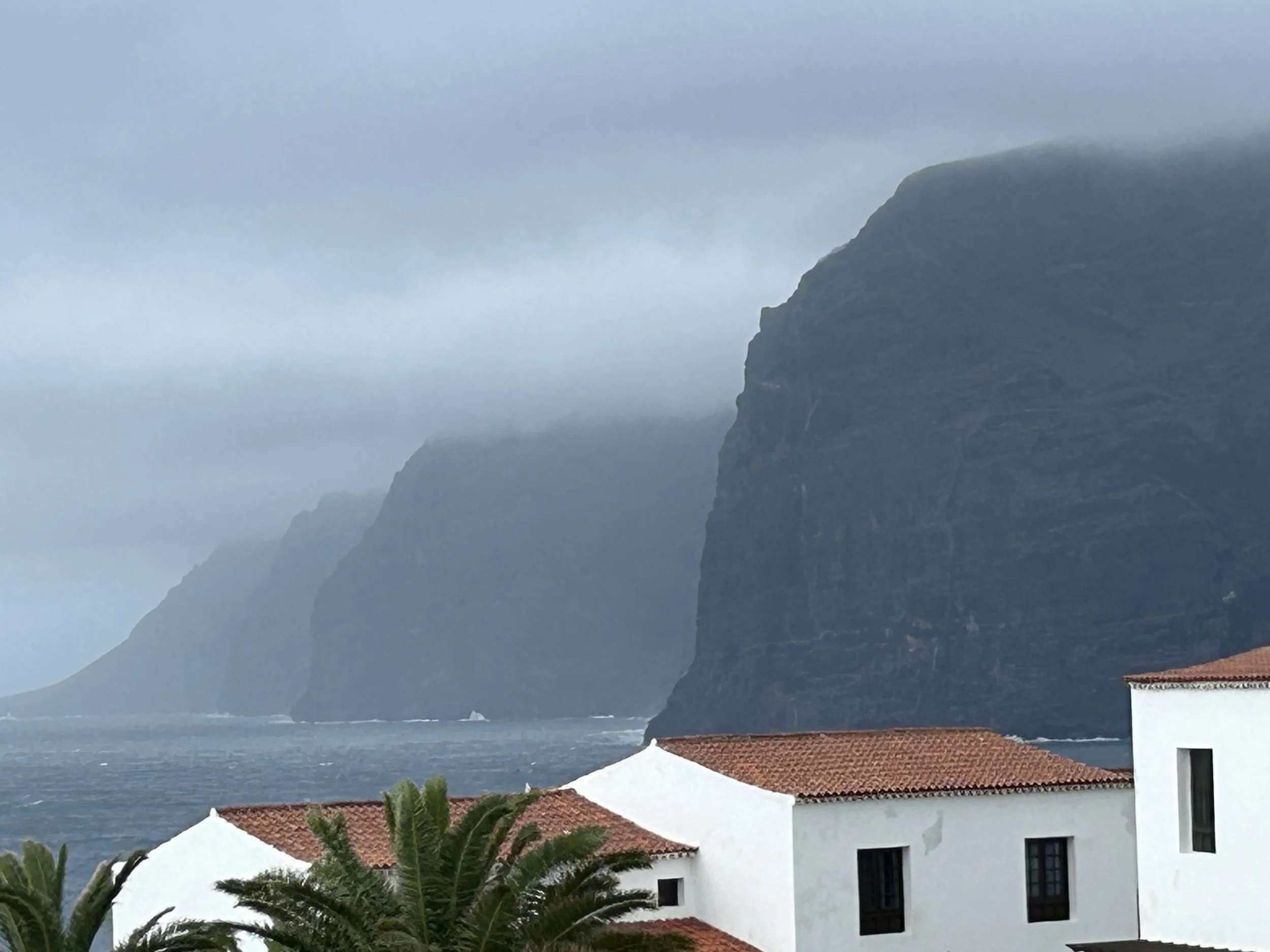
We were lucky with the weather at the start of the holiday, but it didn’t hold. In truth, the storms were never as bad as predicted — we managed a few pool visits between the clouds. There were local reports of the worst storm in years and headlines back home gesturing toward Armageddon-level events that never quite arrived.
We did hire a car and drive around the island, which yielded some genuinely spectacular cliffs and waves. All was not lost.
-----
The Guy with the Snorkel
There is a man at this hotel who spends virtually the entire day in the pool wearing a snorkel mask, going up and down. He appears to be living his absolute best life.
There is also a second fellow who has developed an almost supernatural ability to sense when the pool fountains are about to be turned on, positioning himself accordingly with impressive consistency.
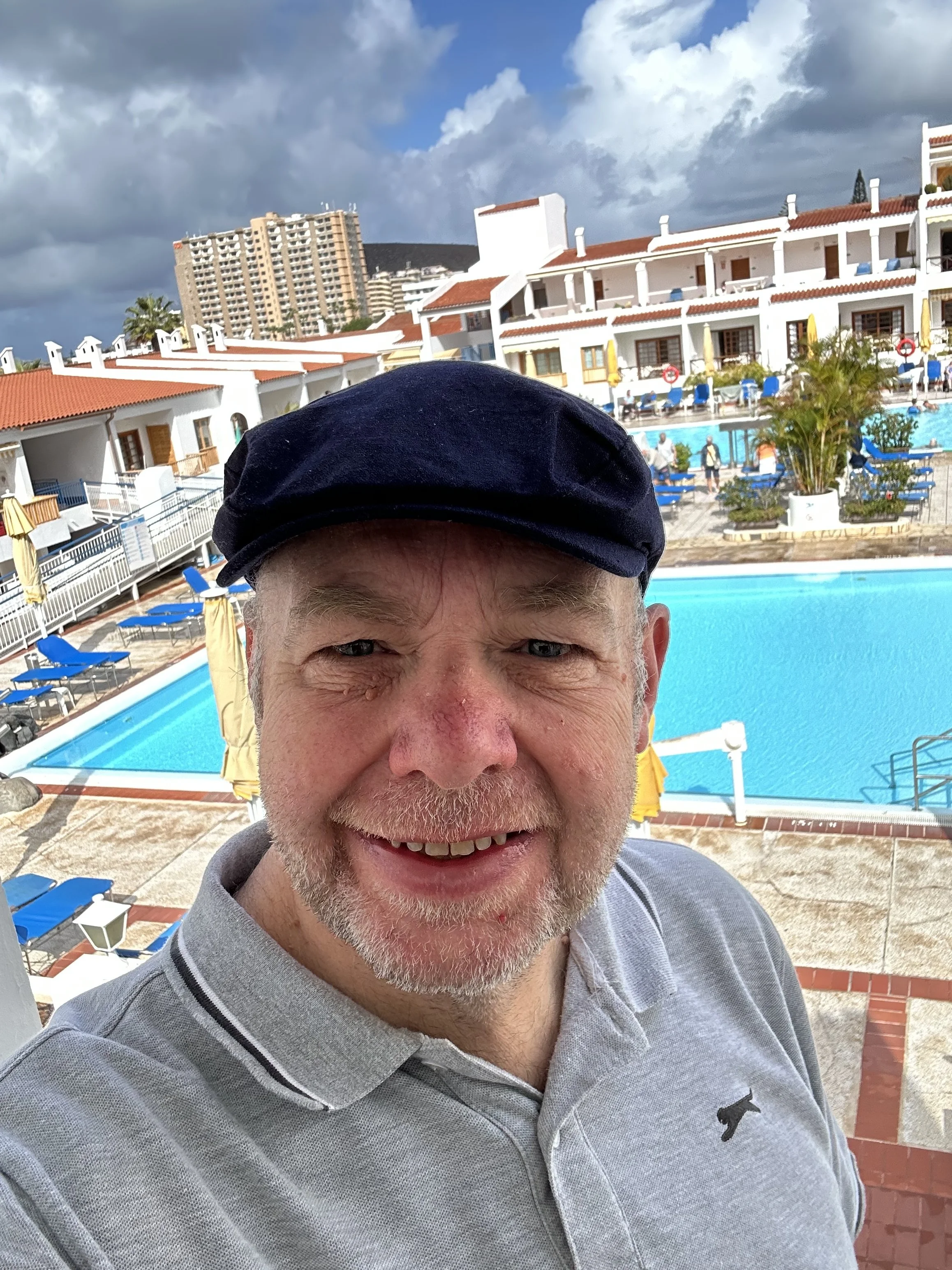
Deb and I did manage to get into the pool a few times. I love swimming with Deb. I have a long-held dream of one day owning a place with an indoor pool. I’ve tried the local leisure centre. It is emphatically not the same. For now, I’ll take what holiday provides and be grateful for it.
-----
Between a Hard Rock and a Burger
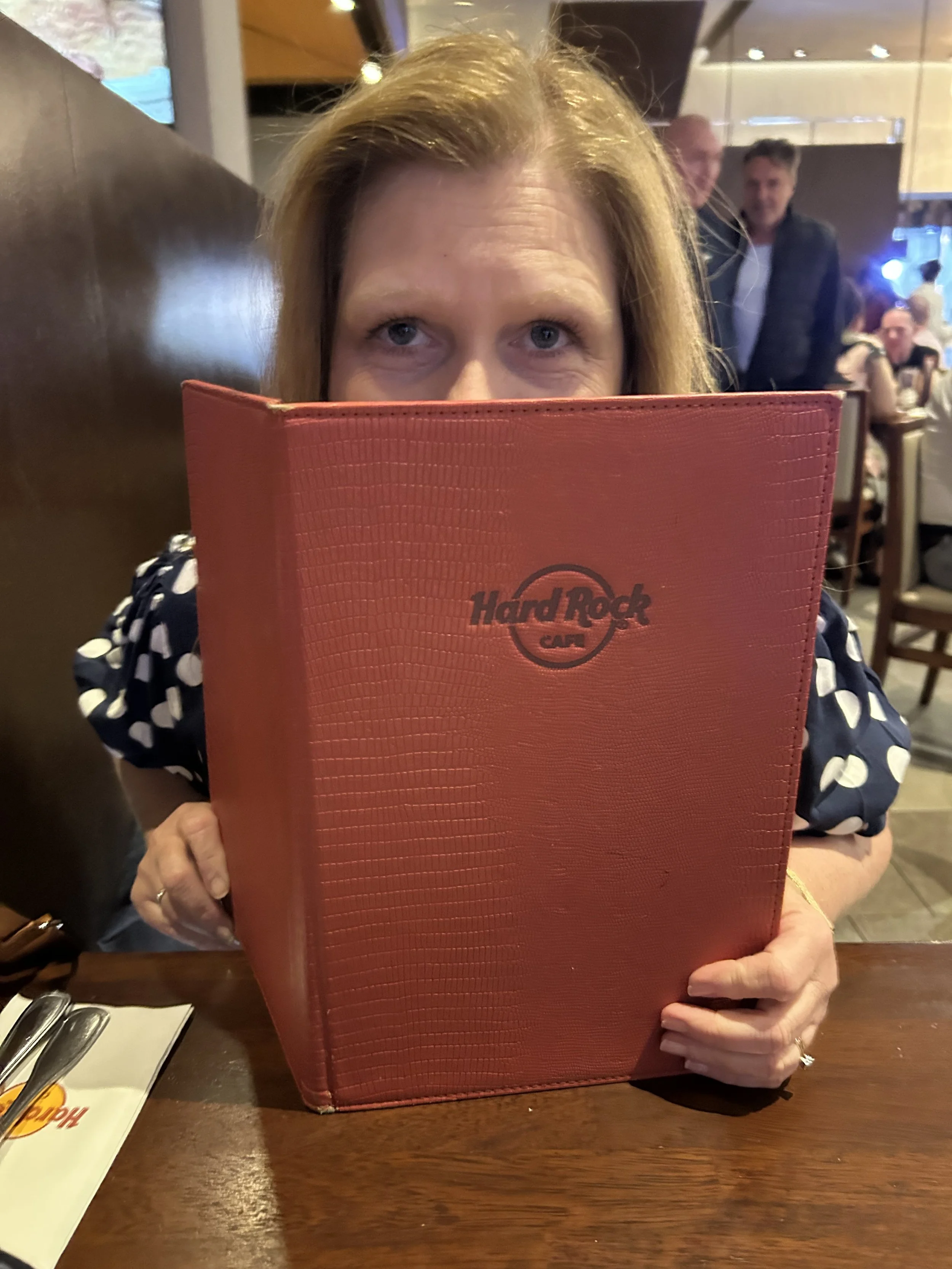
My travelling companion from Australia, Neil Elliott, was understandably put out when I told him myself and Deb had chosen the Hard Rock Café for my birthday dinner. He had every right to be. We have an unspoken agreement that whenever we travel together, we eat local. This rule was born of a previous disagreeable experience in Strasbourg, when Neil insisted on a kebab. It was not good.
In my defence: the burger appears to be the de facto national dish of Tenerife, so I’m not entirely sure I broke the spirit of our agreement. We only went because the weather was bad and it happened to be in the same building as the show we’d booked. My expectations were low. I was, genuinely and happily, wrong. The food was excellent, the atmosphere better than I’d anticipated, and — the cherry on top — the Manic Street Preachers appeared on the video screen.
A good birthday.
-----
A Part of History
Downstairs from the Hard Rock Café was a large theatre hosting a show called *History* — an ambitious production charting the story of music across the centuries. Beethoven to The Beatles. Elvis to Pink Floyd. Michael Jackson, Tina Turner, Prince, U2. Two and a half hours of it, and largely excellent.
Though I should note: the in memoriam section for deceased male artists was accompanied, for reasons I could not entirely fathom, by Radiohead’s *Creep*. A choice. Definitely a choice.
And then the finale. After two and a half hours of genuine musical history, phones were raised, lights came on — and we were sent home to the strains of *Angels* by Robbie Williams.
Reader, I have no further comment.
Airport Blues
We had been warned about Tenerife South Airport. Honestly, it wasn’t the worst — we got through eventually. But there were plenty of others rather firmly stuck in the customs queues. We were travelling off-season. I would not wish to attempt it at peak.
-----
Final Thoughts
If we ever do this again — and that remains genuinely open — I’d trade some of the accessibility provisions for rather more luxury. The hotel clearly serves a genuine need: it is well-equipped for guests with serious mobility requirements, and it is obvious that many people love it and return year after year. But the rooms were tired, the food uninspired, and the whole place carried a faint air of the slightly peculiar.
Tenerife itself is not really for us. We prefer somewhere quieter, less aggressively touristic. There are clearly people for whom it is exactly right — the bars, the entertainment, the shopping, the reliable warmth. Each to their own. But it has rather too much of the Blackpool-with-better-weather about it for my taste. Thank you, Tenerife. We won’t be back.
-----
What’s Next
Time to say goodbye to Tenerife and look forward to very different Spanish adventures.
Next up: Bilbao. I visited with Neil some years ago and knew immediately it was somewhere I had to bring Deb. The culture and food are exceptional, and the Guggenheim Museum alone is worth the journey. If that’s your kind of thing — and it absolutely should be — watch this space. More dispatches from Spain, coming in July.
-----
*Wayne Gough writes at [waynegoughblog.com](https://waynegoughblog.com)*